From First-Come-First-Serve to Appointment-Based Allocation: How a Global Snacks Company Improved Fill Rates by 4% Across Channels without Adding Inventory
A global snacks company was not facing a demand problem, it was facing an allocation intelligence problem. As three channels began competing for the same depot-level inventory, First-Come-First-Served could no longer protect fill rates or urgent delivery windows. With JAVIS, the company is betting on smarter allocation and real-time appointment visibility to defend fill rates without adding inventory.
- Fill rate improvement
- +4%
- Quick commerce stockouts
- -35%
- Channels, one inventory pool
- 3
- Q-com dispatch windows
- 3-5 days
Challenge
Competing channels, same inventory, no allocation intelligence
With the rapid rise of Quick-Commerce, the traditional distribution mix between General Trade and Modern Trade has now become a three-channel operating environment, with Quick-commerce now accounting for an estimated 70% to 75% of all online grocery orders in India, up from 35% in 2022.
For the company, that shift created a new execution problem. Modern Trade purchase orders carried lead times of 15 to 30 days. Quick commerce orders required dispatch within 3 to 5 days. When both channels drew from the same depot-level inventory, whichever order entered the system first consumed available stock, regardless of which channel had the tighter dispatch window, an upcoming delivery appointment, or a stricter freshness requirement.
The conflict was not supply. It was allocation intelligence.
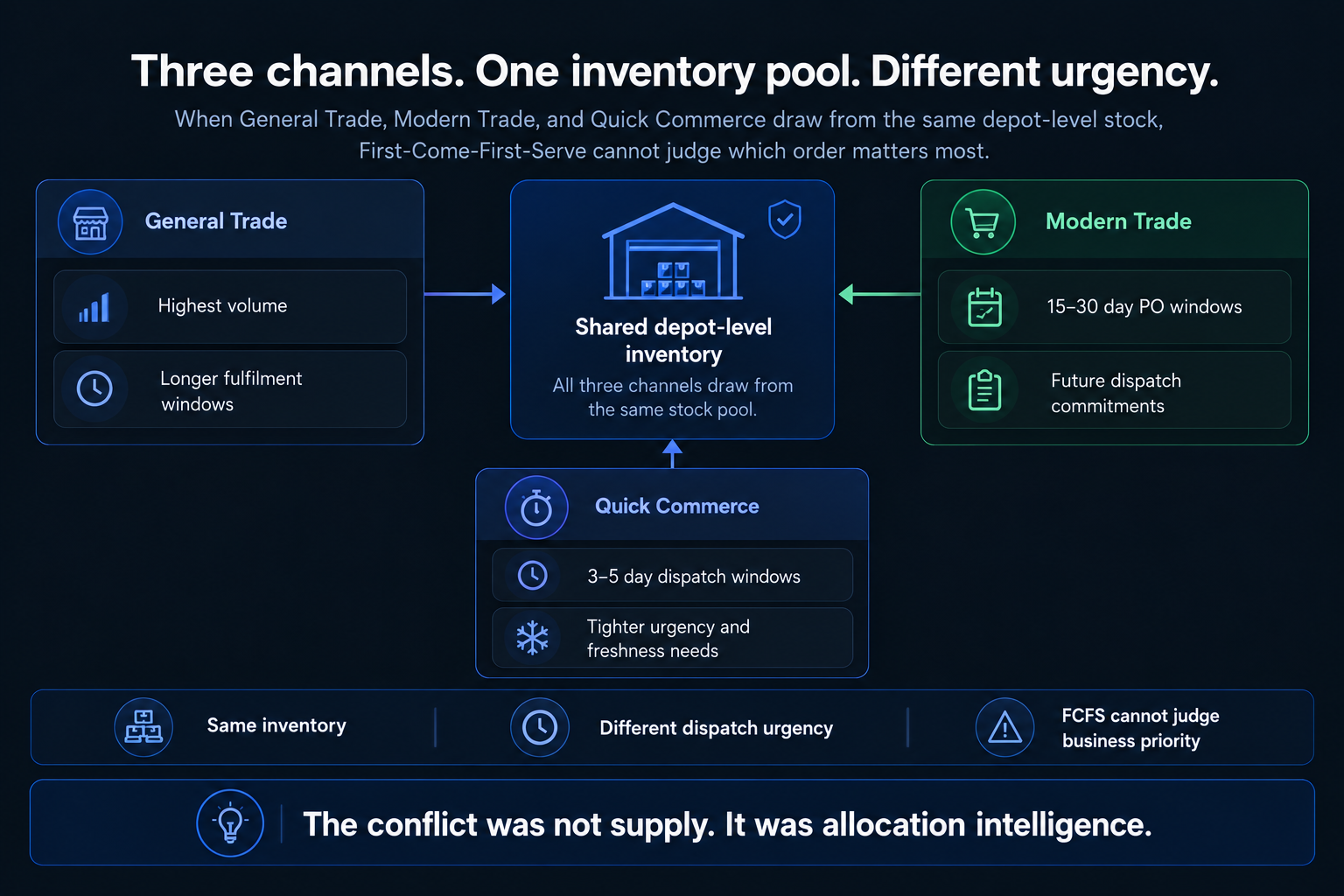
A Modern Trade order arriving early in the morning was routinely consuming the same SKU that a Quick-commerce dark store needed dispatched within hours. Stock was not the constraint, how stock was being allocated against competing demand was.
Fill rates dropped by 4%, over two quarters as Quick-commerce volume grew and the allocation gap widened with it. The company turned to JAVIS, the autonomous order execution platform, to fix it.
Solution
Replacing First-Come-First-Serve with Appointment-Based Allocation
The company was not facing a demand problem. It was facing an allocation problem.
JAVIS connected incoming demand with live inventory, credit conditions, and dispatch schedules. Instead of allowing inventory to be consumed by the order that arrived first, JAVIS evaluated which order should be fulfilled first based on dispatch urgency, delivery type, and the cost of a miss.
Three things needed to be solved:
- 1Eliminate premature stock blocking by committing inventory only when dispatch is operationally due.
- 2Recommend appointments with full visibility into appointment status before PO expires
- 3Prioritise stock allocation across channels based on fulfillment urgency and business priority
This meant the transformation was not limited to automating order processing. It required the company to change how inventory was evaluated, reserved, and released across competing orders and constrained stock.
Teams that had previously worked from static queues and bulky spreadsheets had to trust a system telling them what to act on, in what order, and why. The transformation was completed in three phases.
Phase 1
Eliminating Premature Stock Block: From Order Entry to Appointment-Led Allocation
In the company's order execution flow, once a Sales Order is created in SAP, the system places a soft block on the committed stock quantity. This reduces the Available-to-Promise for all subsequent incoming orders by the soft-blocked quantity, preventing any other order from consuming stock already committed to an existing Sales Order. Under a First-Come-First-Serve model, this meant whichever order entered the system first determined how available stock was consumed, regardless of when that order actually needed to be dispatched.
Modern Trade purchase orders were locking inventory at the moment they entered the system, not at the moment dispatch was required.
The constraint was not supply. It was premature commitment.
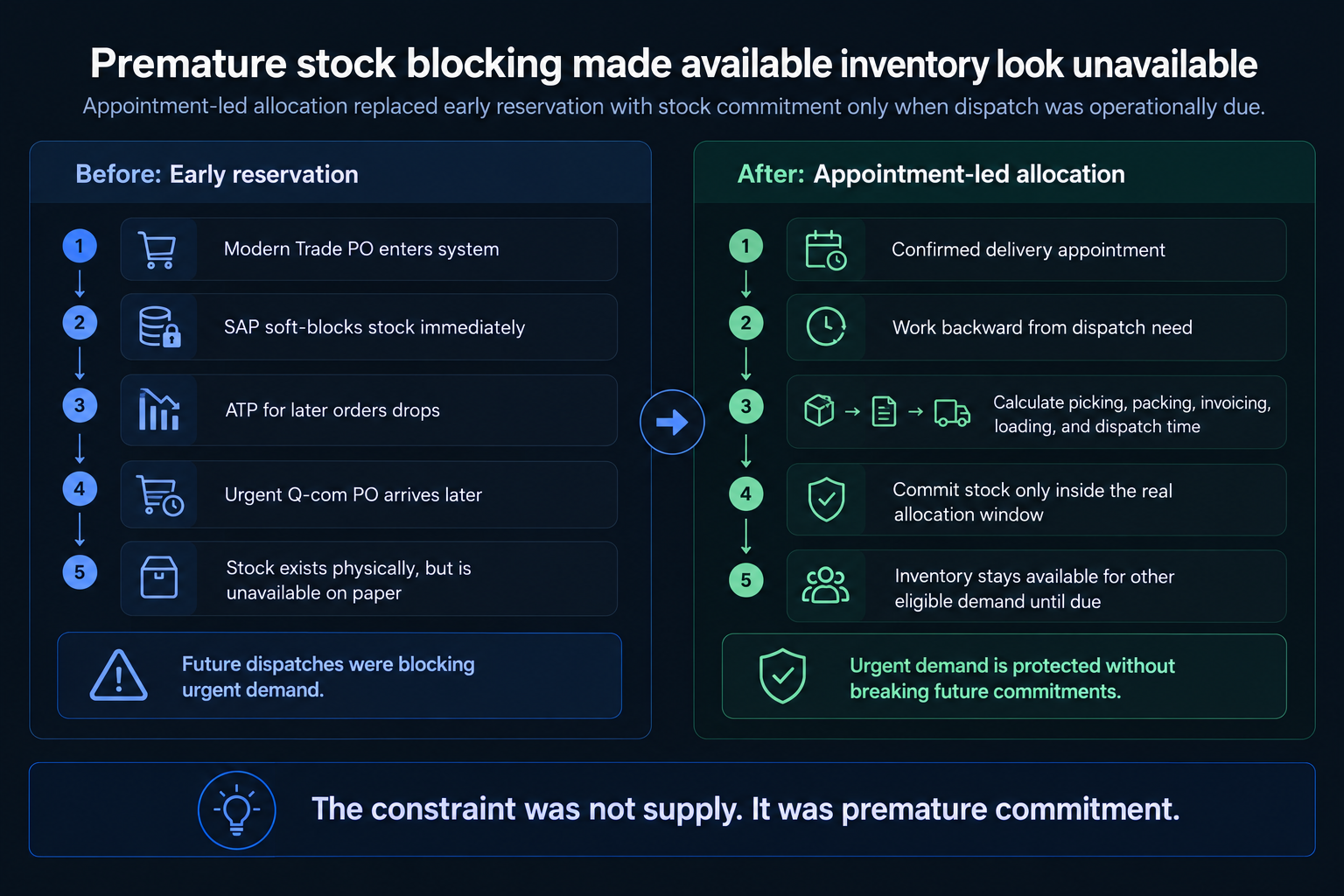
A PO with a delivery appointment three weeks out was consuming the same SKU a Quick Commerce dark store needed dispatched by end of day. The stock existed in the depot. It was simply unavailable, already committed on paper to a future dispatch that was a week away.
The constraint was not supply. It was a premature commitment.
JAVIS replaced early reservation with appointment-based allocation logic. Instead of blocking inventory at the time it hit JAVIS, JAVIS worked backward from each order's confirmed delivery appointment. It calculated the time required for picking, packing, invoicing, loading, and dispatch, and only committed stock when the order was within the actual stock allocation window. Until then, the inventory remained available for other eligible demand across channels.
Modern Trade delivery commitments were protected. Quick Commerce and high-urgency orders were no longer being starved against stock that physically existed in the depot but was sitting blocked against a future dispatch.
The same inventory, governed by a different allocation logic, improved fill rates by 4%.
Phase 2
Recommend appointments with full visibility into appointment status before PO expires
Even after solving how stock was allocated across channels, a different problem remained on the commercial side.
Key account managers were working from a queue of hundreds of open purchase orders with no way to tell which ones still needed a delivery appointment confirmed. Some purchase orders had appointments locked. Others were sitting open with no appointment taken, and no flag to indicate they were at risk.
Delivery windows with Quick Commerce and Modern Trade customers are fixed. Miss the window and the order is gone. But with no visibility into which POs were unactioned, account managers were either chasing the wrong orders or missing the ones that mattered most.
The cost of that gap was not just a missed order. It was lost fill rate, a strained customer relationship, and revenue that could not be recovered.
JAVIS introduced an appointment recommendation engine that worked backward from each order's confirmed delivery window. For every open purchase order, the system evaluated live inventory positions, GIT stock, credit availability, and the lead time required for dispatch to determine whether fulfillment was operationally feasible within the window.
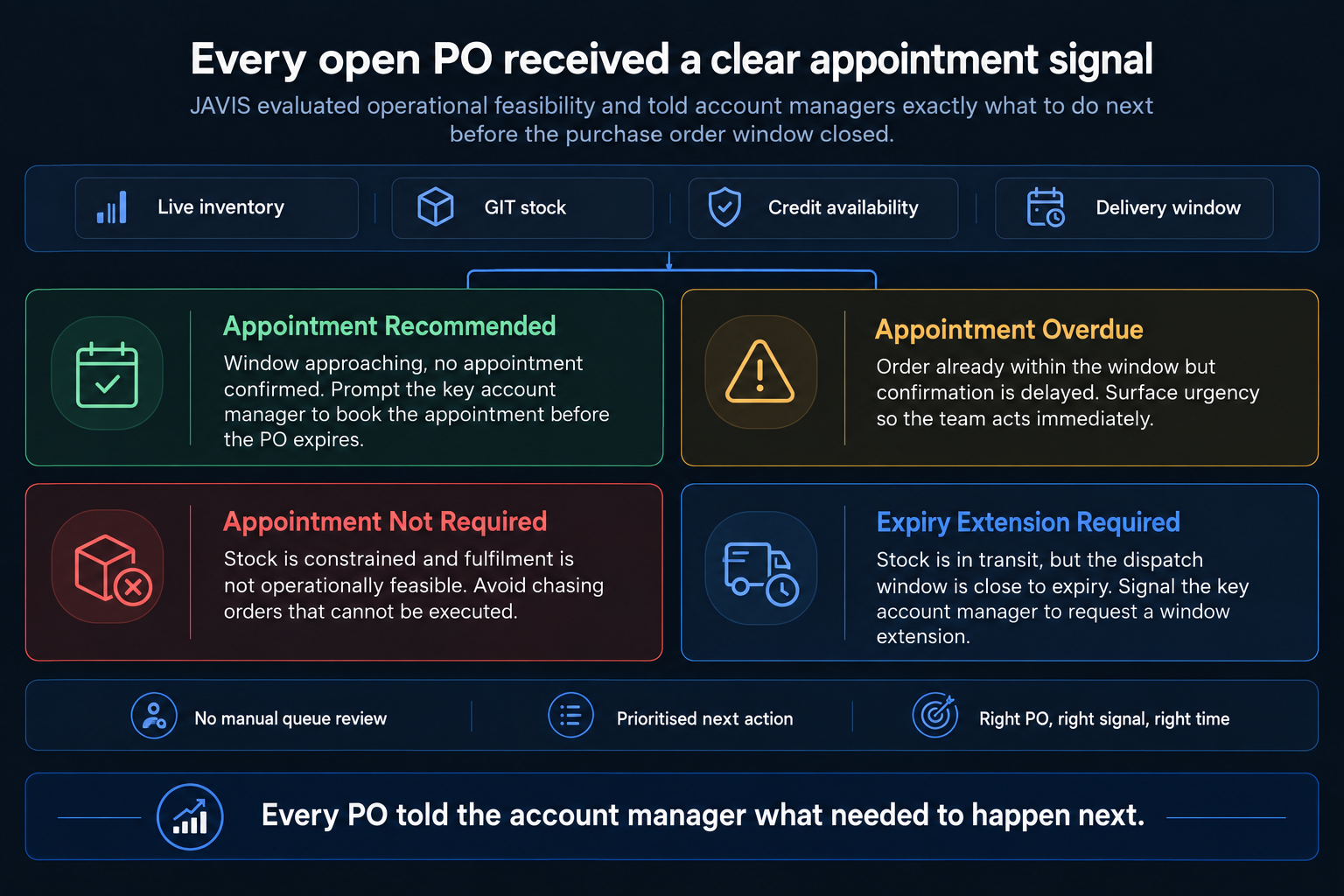
Based on this evaluation, every open purchase order was assigned a signal:
Signal 01
Appointment Recommended
Orders approaching their delivery window with no appointment confirmed were flagged as "Appointment Recommended," prompting the key account manager to book the appointment before the window closed.
Signal 02
Appointment Overdue
Orders already within the window where confirmation was delayed were marked "Appointment Overdue," surfacing the urgency directly so the team could act immediately.
Signal 03
Appointment Not Required
Orders where stock availability was constrained and fulfillment could not be completed were classified as "Appointment Not Required," so account managers were not chasing orders that could not be executed.
Signal 04
Expiry Extension Required
Orders where stock was in transit but the dispatch window was close to expiry were flagged as "Expiry Extension Required," giving the key account manager a clear signal to reach out to the customer and request a window extension before the order was lost entirely.
Every signal was a direct instruction to the right person at the right time. No manual review. No digging through queues.
Each purchase order told the account manager exactly what needed to happen next and how much time remained to act. No PO required a manual review to surface. No appointment was missed because it sat unnoticed in a queue.
For the first time, zero purchase orders went unnoticed. Key account managers were not scanning a list. They were responding to a prioritised signal telling them exactly which customer needed to be called next.
Phase 3
Prioritise stock allocation across channels based on fulfillment urgency and business priority
Appointment-based allocation solved when inventory was committed. It did not solve which order should receive it first when stock was short.
In a three-channel environment, constrained stock could still default to the wrong order. Not because the system lacked inventory visibility, but because it lacked a rule for how to rank competing demand.
Without a priority framework, a General Trade order and a Quick Commerce order drawing from the same SKU had no deterministic outcome. Whichever arrived first won, regardless of which carried the higher cost of a miss.
The constraint was not inventory. It was the absence of a ranking logic.
JAVIS replaced First-Come-First-Serve with demand-prioritised allocation. Every incoming order was evaluated against channel priority, delivery urgency, available stock, and fulfillment rules before inventory was committed.
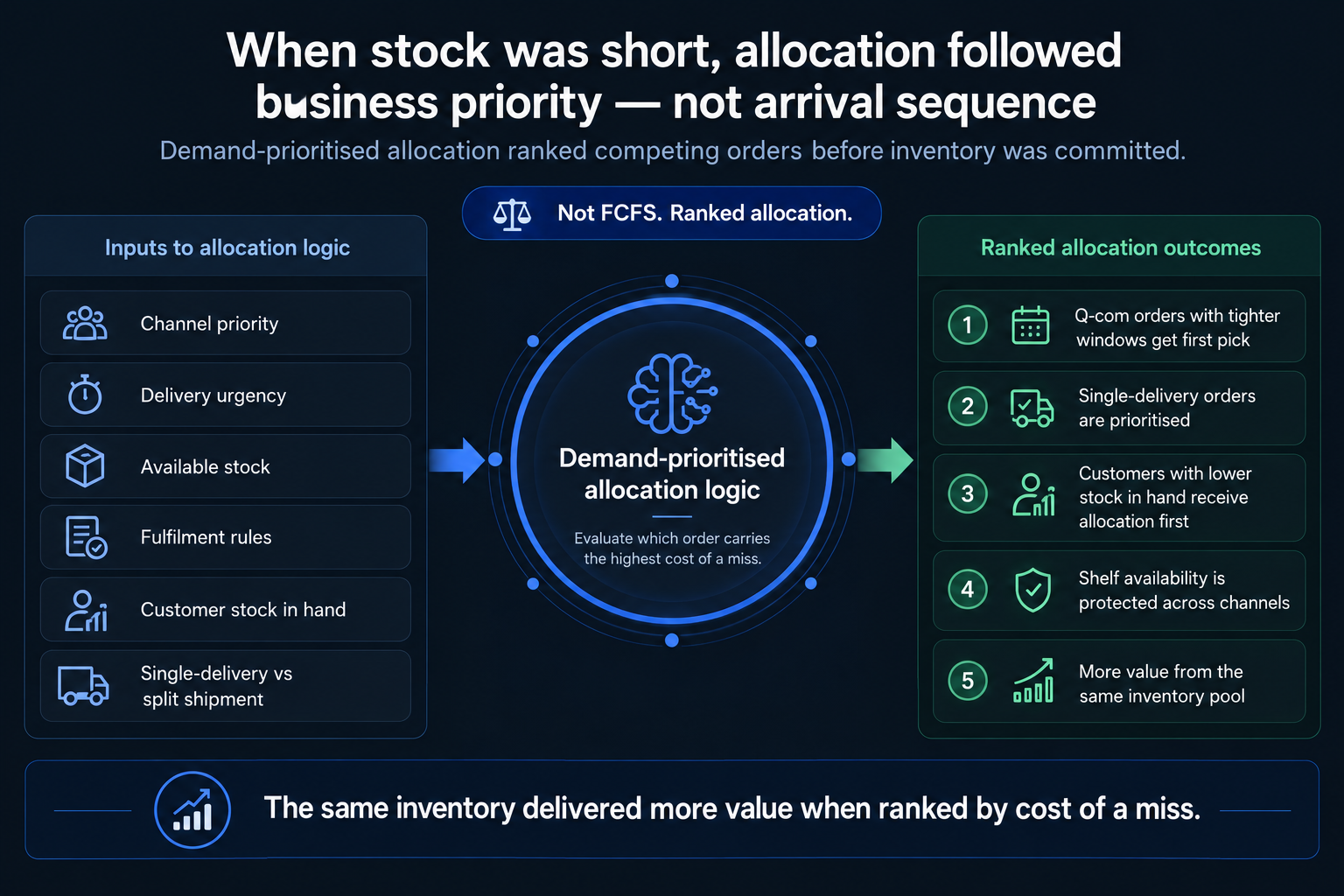
When supply was constrained, pre-configured business priority logic determined how stock was distributed across competing orders. Quick Commerce orders with tighter dispatch windows received first pick over long-lead Modern Trade demand sitting in the same queue.
Within Quick Commerce, single-delivery orders were prioritised over split shipments, keeping OTIF intact. Customers with lower stock in hand received allocation first, so the brand maintained shelf availability across channels before a stockout could occur.
For the first time, allocation was governed not by which order arrived first, but by which order carried the highest cost of a miss. The same inventory pool, ranked correctly, delivered more value from the same stock without adding a single unit to the depot.
Impact
From First-Come-First-Serve to Appointment-Based Allocation
The transformation delivered measurable outcomes across the company's multi-channel fulfillment operations:
+4%
Fill Rate Improvement
Available stock was committed to the channel with the tightest dispatch window, not the order that arrived first. The same inventory, allocated differently, delivered more.
35%
Reduction in Quick Commerce Stockouts
Long-lead Modern Trade orders no longer consumed inventory that Quick Commerce needed dispatched within hours. Stock stayed available for the orders that could not wait.
Final word
What began as an order automation initiative evolved into a fundamental change in how the company makes allocation decisions across every channel, every day. With JAVIS, the company is not just fulfilling orders more efficiently. It is defending fill rate, protecting channel relationships, and building the execution foundation to win in Quick Commerce and Modern Trade at scale.