From Manual Depot Routing to Autonomous Execution: How a $10 Billion FMCG Major Automated Multi-Depot Order Fulfilment Across 500 Depots
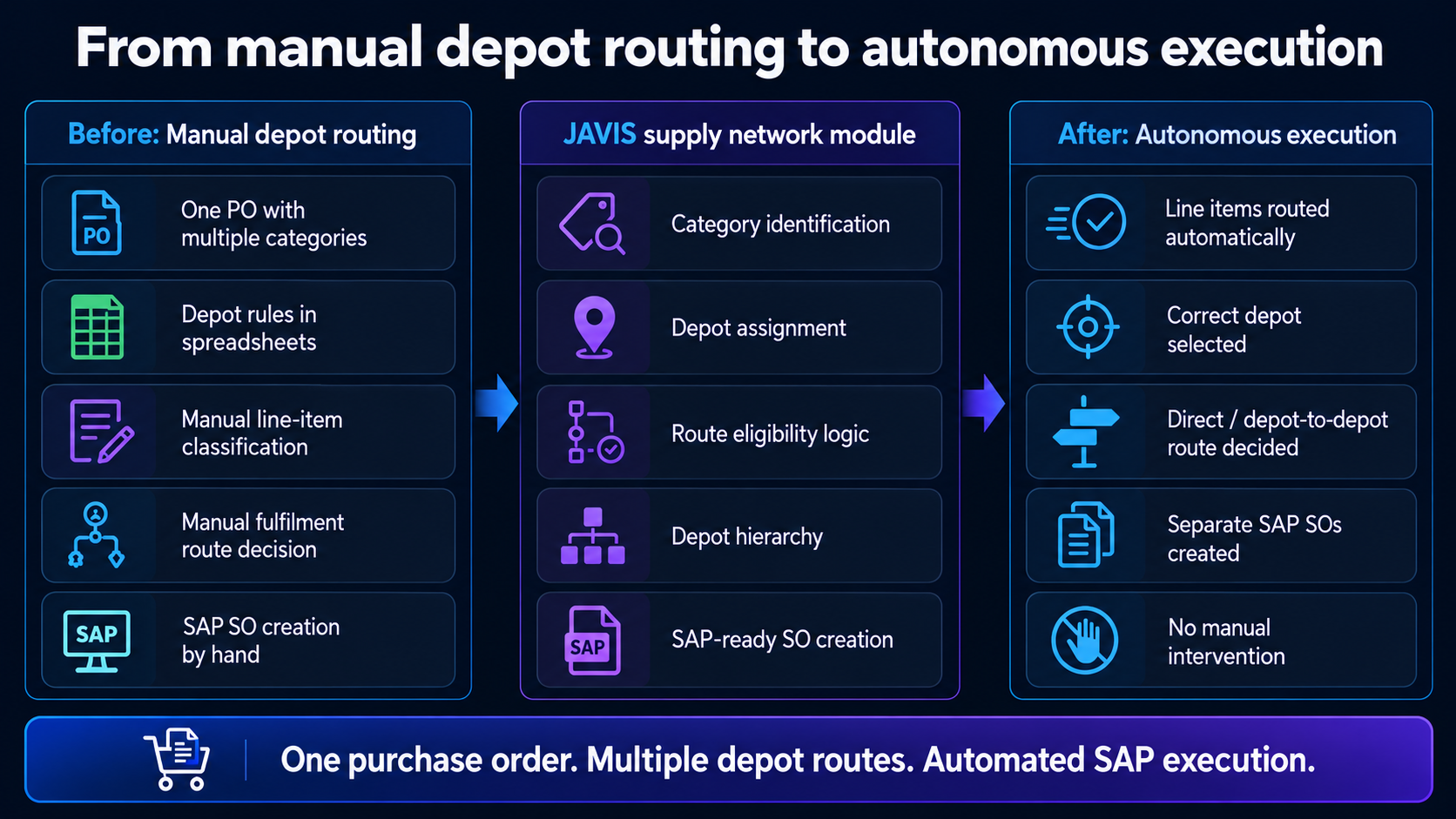
A $10 billion FMCG major's organised trade customers place a single purchase order covering multiple product categories. Behind that single document sits a 500-depot distribution network where categories are segregated by depot, fulfilment routes vary by customer and SKU, and every line item must be classified and routed to the correct depot node before a Sales Order can be created in SAP. With JAVIS, the company automated the full depot assignment and ERP routing flow without manual intervention at any step.
- Automated order routing
- 100%
- Depot Network
- 500
- Product Categories
- 4
- Divisions
- 40+
Challenge
One purchase order. Multiple categories. Multiple fulfilment routes. No automated way to handle any of it.
The company is the second largest FMCG company in India, with approximately 75% market share in cigarettes and a distribution reach spanning over 6 million retail outlets. Serving organised trade at this scale demands precision at every node. A wrong depot assignment or fulfilment route decision translates directly into a missed serviceable window and lost revenue.
Every organised trade purchase order arrives as a single document covering multiple product categories. Behind it sits two layers of structural complexity.
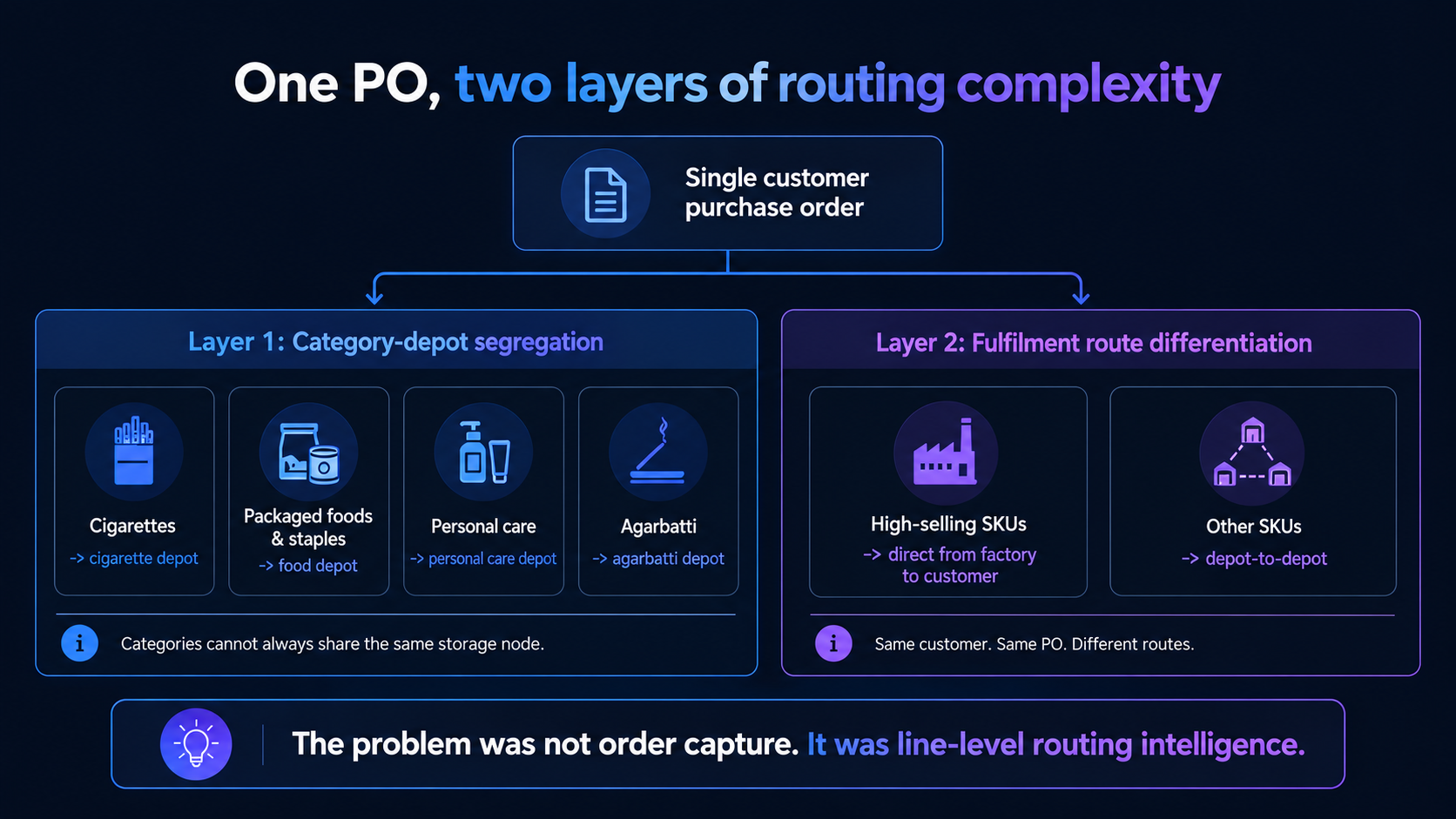
The first is category-depot segregation. Under FSSAI food safety regulations, tobacco and food products cannot be co-located in the same storage facility. Cigarettes reside in separate depots from packaged foods and staples. Personal care and agarbatti carry their own storage requirements. Across the company's 500-depot network, no single depot services all categories.
The second is fulfilment route differentiation. For the same customer, some SKUs ship directly from the company's factory to the customer's depot location, applied for high-selling SKUs where volume justifies bypassing the distribution depot entirely. Other SKUs for the same customer move through the standard depot-to-depot route. Both routes can exist within the same purchase order for the same customer.
Identifying which line item belonged to which depot and which fulfilment route required manual interpretation at every step. Neither error was recoverable without significant operational intervention.
The company turned to JAVIS, the autonomous order execution platform, to fix it.
Solution
One intelligence layer across every depot, every category, and every fulfilment route.
The company did not need a new ERP. It needed a layer that could sit between the incoming purchase order and SAP, read every line item, and send each one to the right depot via the right delivery route without anyone doing it manually.
JAVIS was already processing orders for some of India's largest FMCG companies. What the company needed was not a new platform and not a single line of new development. JAVIS's supply network module was plug and play. The company's depot rules, category assignments, and delivery route logic were configured directly into the module without any coding or technical implementation effort. Once configured, the module governed every routing decision on every incoming order automatically.
Three things needed to be solved:
- 1Configure the company's depot network, category rules, and delivery route logic into JAVIS's supply network module.
- 2Read every line item in an incoming order, identify which category it belongs to, and send it to the right depot automatically.
- 3Decide the right delivery route for each line item at the point of order, direct from factory to customer for high-selling SKUs and depot-to-depot for the rest, without manual intervention.
The company's technology team did not need to build anything, configure any system, or write a single line of code. JAVIS's supply network module was designed to be configured entirely through the platform interface.
The company's operations team loaded the depot rules, category assignments, customer-level division routing, and delivery route eligibility directly into the module. The moment the configuration was complete, the module was live and processing orders.
Routing Flow
Automating order routing across the company's 500-depot network
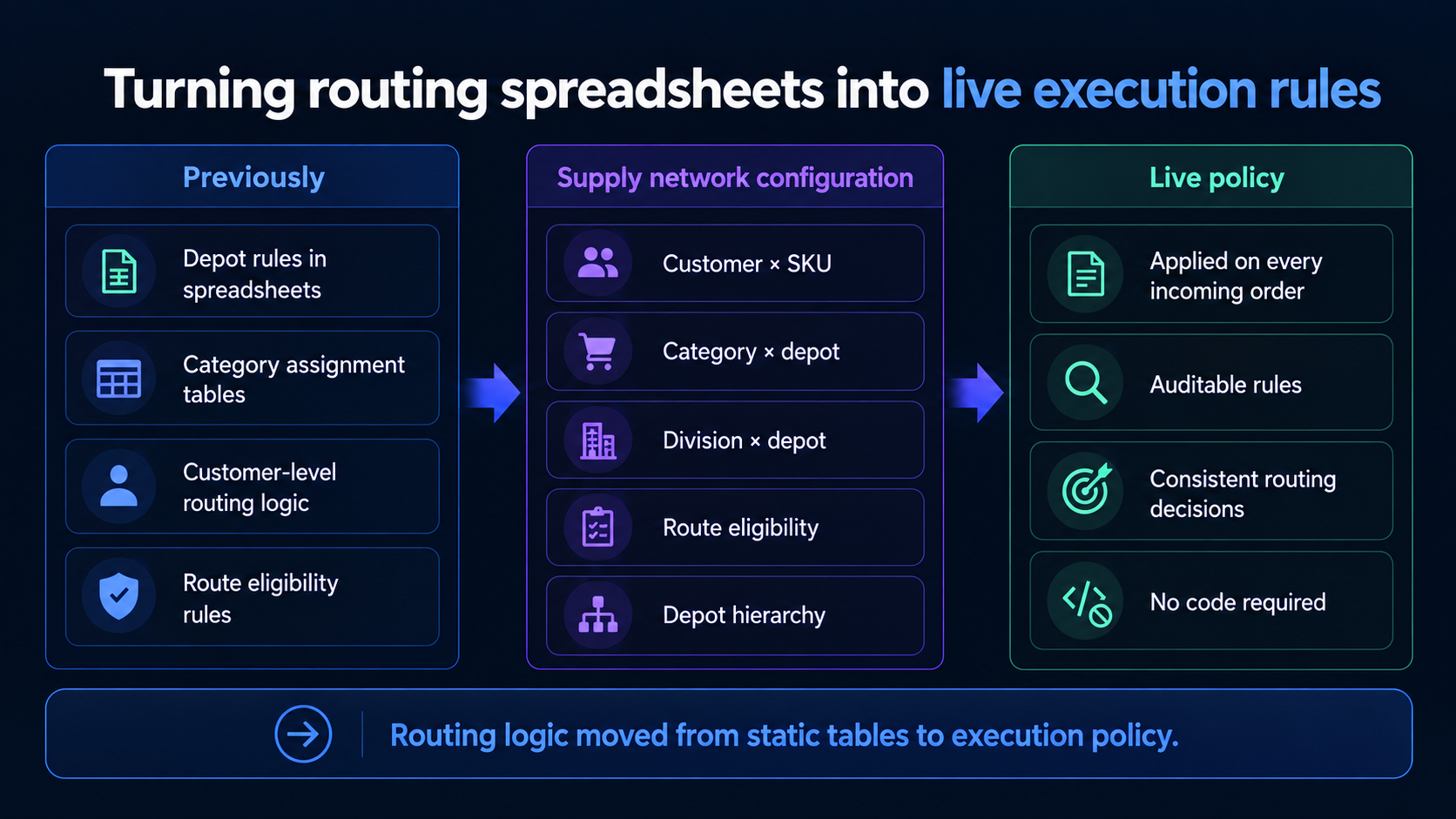
The company's depot routing logic was spread across spreadsheets and routing tables that no one could query in real time when an order arrived. JAVIS's supply network module brought all of this into one place and automated the full routing flow across three steps.
Step 01
Configuring the network rules
For every customer, the module defined which product category and division should come from which depot. Cigarettes had to come from the cigarette depot, as FSSAI regulations do not allow tobacco and food to be stored together. Packaged foods, staples, personal care, and agarbatti each had their own depot nodes.
For every SKU and customer combination, the module defined the primary fulfilment depot and the depot tier hierarchy. Delivery route eligibility was configured at the same level, direct from factory to customer warehouse for eligible high-selling SKUs, and depot-to-depot for the rest.
Routing rules that had previously lived in spreadsheets were now live policy, applied the same way on every single order across the network.
Step 02
Automatic line-level classification and depot assignment
Every incoming purchase order arrived as one document covering multiple categories. JAVIS read each line item, checked which category and division it belonged to, and matched it against the routing rules. Cigarette lines went to the cigarette depot. Food lines went to the food depot. Personal care, staples, and agarbatti each went to their own depot nodes.
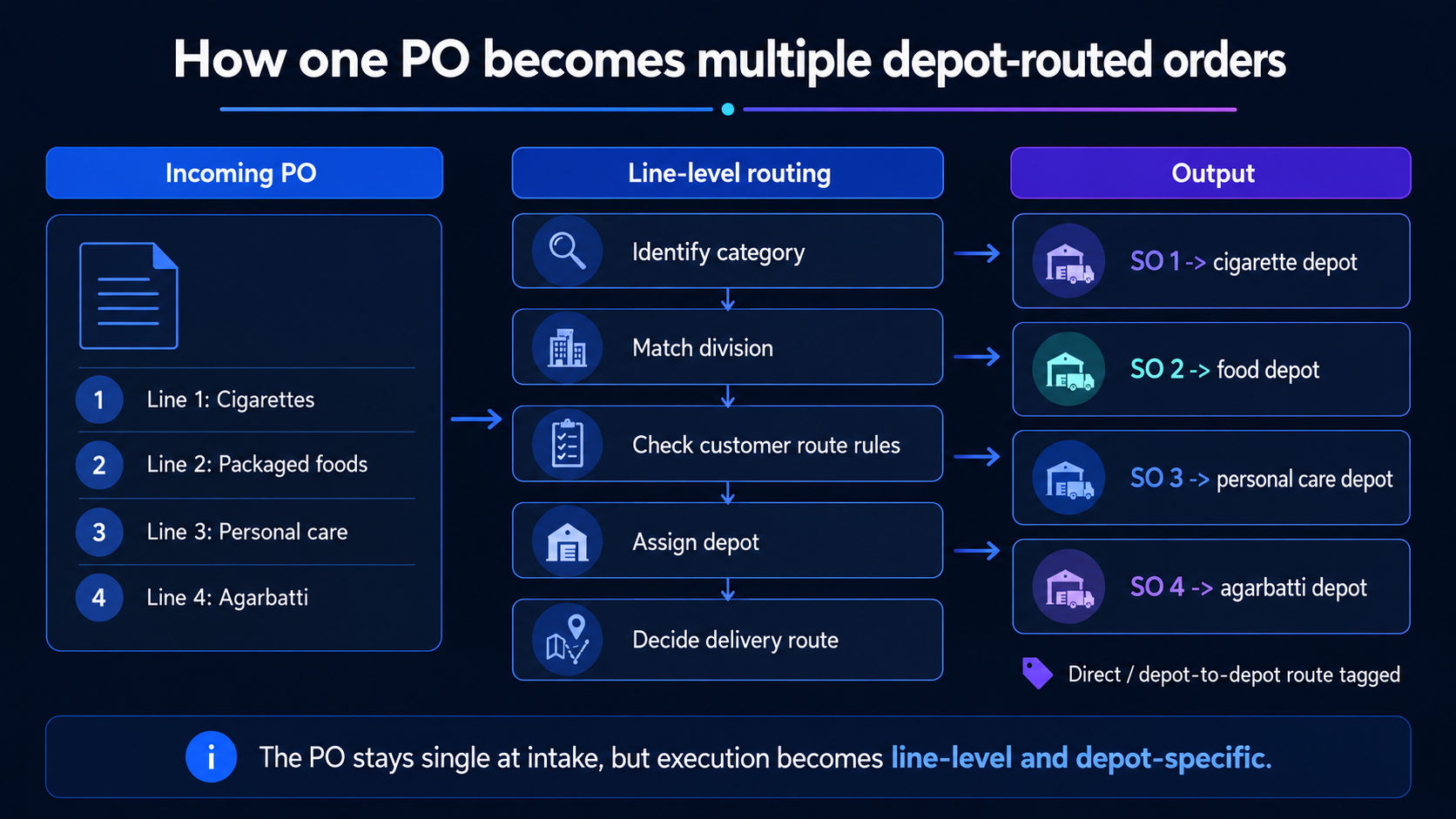
The delivery route was decided at the same step. Lines going directly from factory to customer were flagged for direct delivery. Everything else went through depot-to-depot.
Step 03
Automated SAP execution
JAVIS created separate SO Numbers in the SAP for each depot and each delivery route, with the correct line items, quantities, and routing details, and pushed them into SAP automatically.
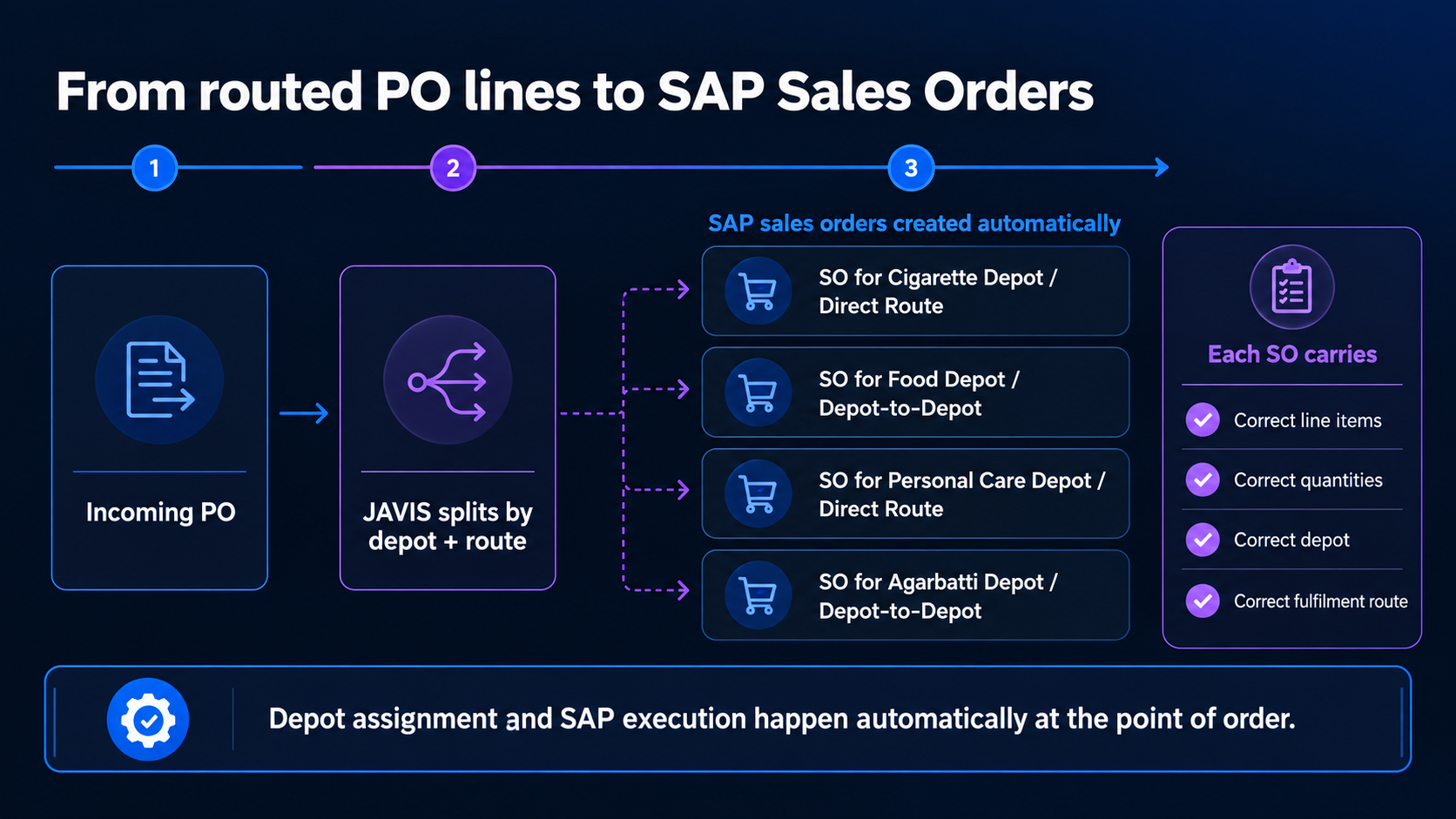
Before JAVIS, every incoming PO required the same manual steps. Read the order. Work out which lines go where. Decide the delivery route. Create the SAP records by hand. Every step was a place where errors happened.
With JAVIS, all of this ran automatically the moment the order arrived. The right depot and the right delivery route were decided at the point of order, every time, without a single manual step.
Impact
From manual routing to 100% automated multi-depot execution
Hands-free Order Processing
Every incoming purchase order, however many categories it covers, is classified line by line and routed to the correct depot and route without a manual step. Reading, classifying and keying orders into SAP used to be done by hand. It now runs end to end with no human touchpoint.
Reduction in Fulfilment Route Errors
Delivery route decisions, direct factory-to-customer or depot-to-depot, are now determined automatically at the point of order for every line item. Misrouting and unnecessary depot legs caused by manual classification have been eliminated across the network.
500 depots, 4 categories, 40+ divisions, One execution layer
The full depot topology, category rules and route logic now run through a single rules engine inside JAVIS. Routing decisions that once lived in spreadsheets are now auditable, real-time policy, applied consistently to every order.
Final Word
What began as a routing problem evolved into a structural advantage. With JAVIS, the company has turned one of India's most complex distribution networks into a fully automated execution engine, where every purchase order is classified, routed, and pushed into SAP without a single manual step. At the company's scale, that is not an operational improvement. It is a competitive one.