From National Credit to Depot-Level Intelligence: How One of India's Largest FMCG Companies Cut Order Losses in Organised Trade
The organised trade customers of one of India's largest FMCG companies operate on national credit limits, but fulfilment happens depot by depot. As orders moved across hundreds of depot-customer combinations, credit was getting consumed where demand was not highest, while eligible orders were being declined elsewhere. With JAVIS, the company created a dynamic credit assignment engine that evaluates live demand, credit headroom, inventory availability, and open order pipelines before assigning credit at the depot level.
- Credit visibility
- Live
- Depot-Customer Combinations
- 100+
- Credit Visibility
- Real-Time
- Credit Assignment Inputs
- 3
Challenge
National credit limits could not reflect depot-level demand
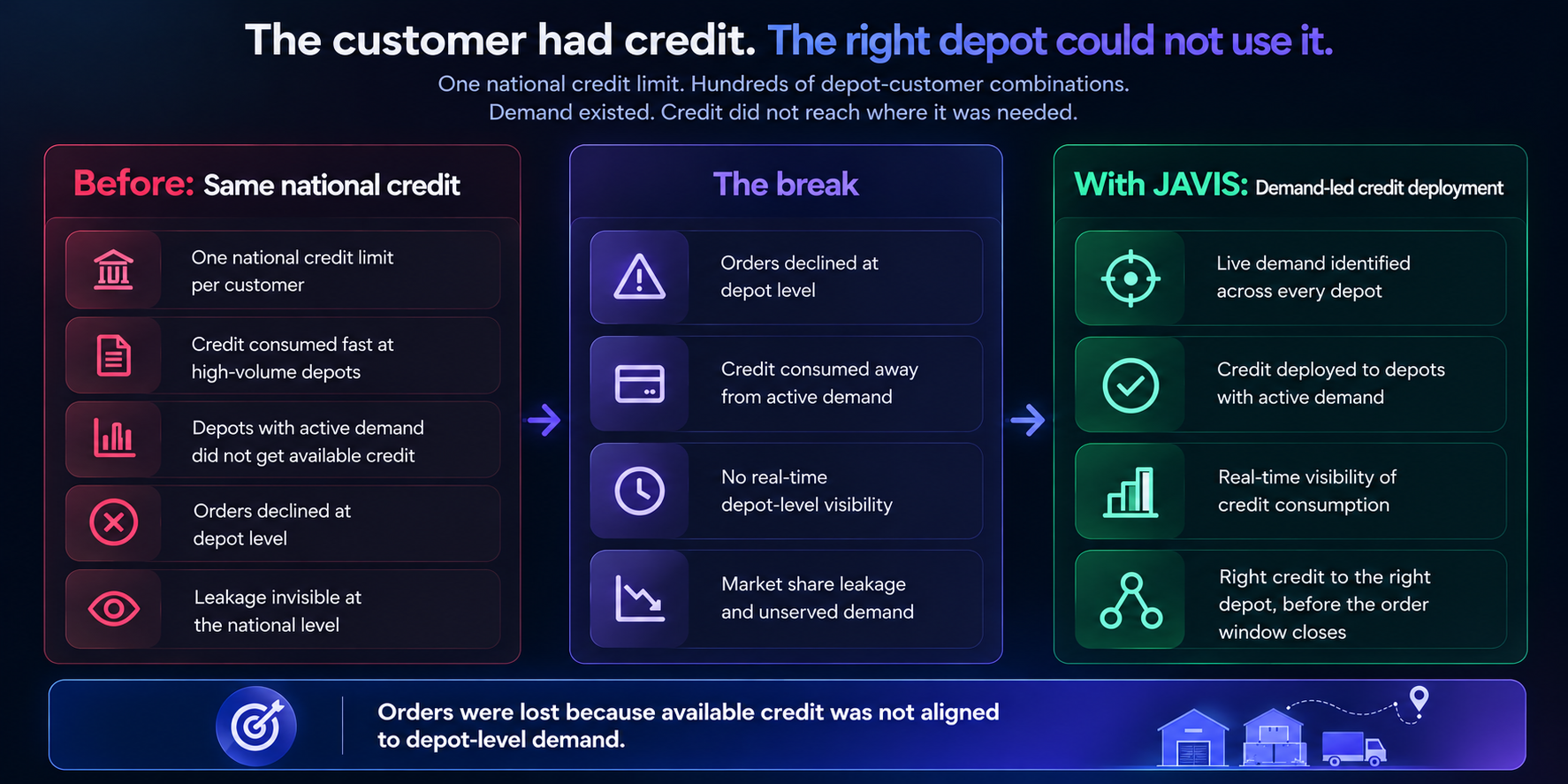
The company's organised trade credit was sanctioned at the customer level. But orders were raised and fulfilled at the depot level.
The same customer could have demand across multiple depots at the same time. High-volume depots could consume credit first, while other depots with active demand were left blocked later in the cycle.
The problem was not that the customer had no credit. The problem was that credit was not being assigned against the right depot-level demand at the right time.
The result was order loss, unserved demand, and market share leakage that was invisible at the national credit-limit level.
The company turned to JAVIS, the autonomous order execution platform, to fix it.
Solution
Building a depot-level credit assignment engine for live demand
The company did not need a new credit policy. It needed an execution layer that could take each customer's national credit limit and deploy it intelligently across every depot-customer combination in real time, based on where the demand actually was.
JAVIS was already managing order execution across the company's depot network. The credit allocation problem required the same execution layer to become credit-aware, evaluating available credit headroom, live order flow, remaining demand in the pipeline, and depot-level inventory simultaneously before committing credit to any single depot.
Two things needed to be solved:
- 1Make national credit visible at the depot-customer level.
- 2Assign credit dynamically based on live demand, inventory availability, and credit headroom.
The Engine
Building the Dynamic Credit Assignment Engine
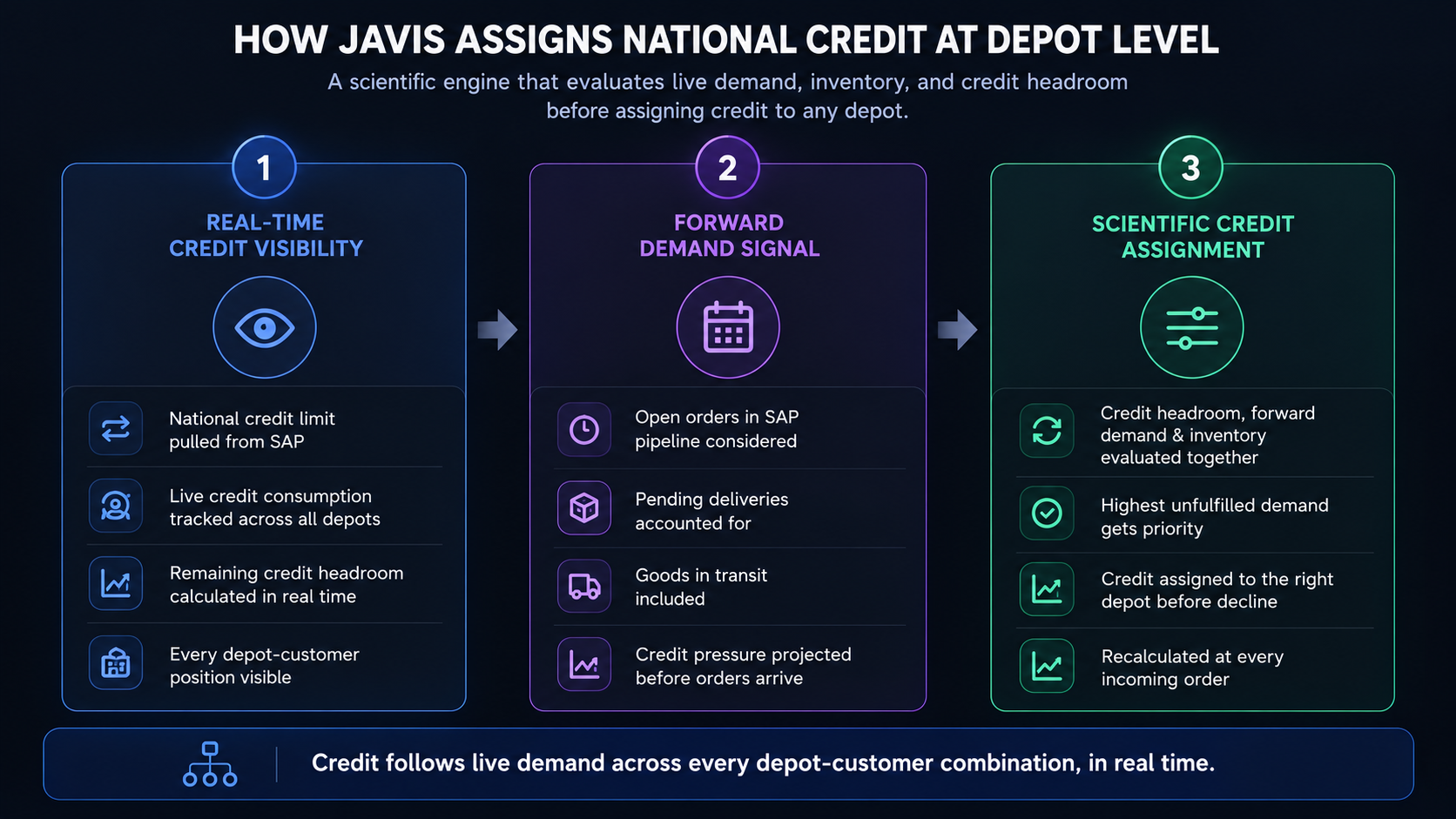
JAVIS introduced a scientific credit assignment engine that operated at the depot-customer combination level, not at the national level. The engine was built across three steps.
Step 01
Real-Time Credit Visibility Across Every Depot
Before credit could be deployed intelligently, JAVIS needed to know exactly how it was being consumed across the network at any given point.
For every organised trade customer, JAVIS pulled the national credit limit from SAP and calculated live credit consumption across every depot servicing that customer simultaneously. This gave JAVIS a real-time view of how much of the national credit had been consumed, how much remained available, and how that remaining credit was distributed across depot-level order pipelines at any point in time.
Previously, this visibility did not exist. Credit consumption was tracked at the national level, not at the depot level. No one could see in real time which depots had consumed the most credit, which had capacity remaining, or where the next order was most likely to be declined.
With JAVIS, that visibility was live and continuous at the point of every incoming order.
Step 02
Forward Demand Signal Across the Depot Network
Knowing current credit consumption was not enough. JAVIS needed to know where credit would be needed before the orders arrived.
JAVIS evaluated the live order pipeline across every depot-customer combination, including orders already in the SAP pipeline, pending deliveries, and goods in transit. This allowed JAVIS to calculate not just current credit consumption but expected future credit consumption across every depot, giving the engine a forward-looking view of where credit pressure was building before it became a declined order.
This forward demand signal was critical. A depot that had available credit today but a large order pipeline arriving tomorrow was a different credit risk from a depot with low demand and no pipeline. JAVIS factored both into every credit assignment decision.
Step 03
Scientific Credit Assignment at the Depot-Customer Level
With real-time credit visibility and a forward demand signal in place, JAVIS built the credit assignment logic.
For every incoming order, JAVIS combined three inputs simultaneously: remaining national credit headroom, forward demand at each depot, and inventory availability at each depot. Credit was not assigned on a first-come-first-served basis. It was assigned based on which depot-customer combination had the highest active demand, the most constrained credit position, and the inventory available to fulfil the order.
When national credit was constrained, JAVIS applied demand-prioritised credit allocation logic. Depot-customer combinations with the highest unfulfilled demand and the tightest credit position received credit priority. Depots where demand was low or inventory was unavailable did not consume credit that higher-priority depots needed.
This was not a static rule. The credit assignment logic evaluated every incoming order against the live state of the network at that point in time. Credit positions changed as orders were fulfilled and new orders arrived. JAVIS recalculated the optimal credit deployment continuously, ensuring national credit followed live demand across the network in real time.
For the first time, the company had a scientific, real-time view of how national credit was being consumed and deployed across every depot-customer combination, and a system that ensured available credit reached the right place before the order was lost.
Impact
From Static Credit Pools to Demand-Aligned Credit Deployment
Hands-free Credit Allocation at the Depot Level
Every incoming order is evaluated against live credit headroom, forward demand and depot inventory before credit is committed, with no manual intervention at any step.
Credit that Follows Priority, Not Arrival Order
Credit is no longer consumed by whichever depot raises an order first. Each assignment goes to the depot-customer combination with the highest active demand and the tightest credit position at that moment.
Market Share Protected Where It was Quietly Leaking
Orders lost to credit stranded at the wrong depot were market share leakage that never showed up at the national level. Demand-aligned credit deployment closed that gap, so available credit reaches the right depot before the order window closes.
Final Word
The company's credit challenge was not a policy problem. The credit existed. The customers were eligible. The inventory was available. The gap was that no system existed to deploy national credit at the granularity the depot network demanded. With JAVIS, credit follows demand in real time across every depot-customer combination, and available credit reaches the right place before the order is lost.