How a $1.5 Billion FMCG MNC Automated 100% of its Q-Commerce Orders in India and Lifted Fill Rates by 5%
After Q-commerce compressed lead times to three days, a $1.5 billion FMCG MNC's order execution is moving beyond manual workflows - betting on autonomous order capture, zero-touch SAP integration, and demand-prioritised allocation to defend fill rates in India's fastest-growing FMCG channel.
- Fill rate improvement
- +5%
- To Full Production
- 10 days
- Orders Automated
- 100%
- Mismatch Dispatches
- Zero
Challenge
Q-commerce scaled faster than the operations behind it
Quick commerce is one of the fastest-growing retail channels in India. Q-com's share of FMCG sales has grown from 1% in 2022 to over 4% in 2024, and is projected to cross 8-10% by 2027 as Blinkit, Zepto and Swiggy Instamart continue to expand across Tier 1 and Tier 2 cities.
For the company, which holds market leadership in categories like health supplements, juices and oral care, winning in Q-com is a board-level priority.
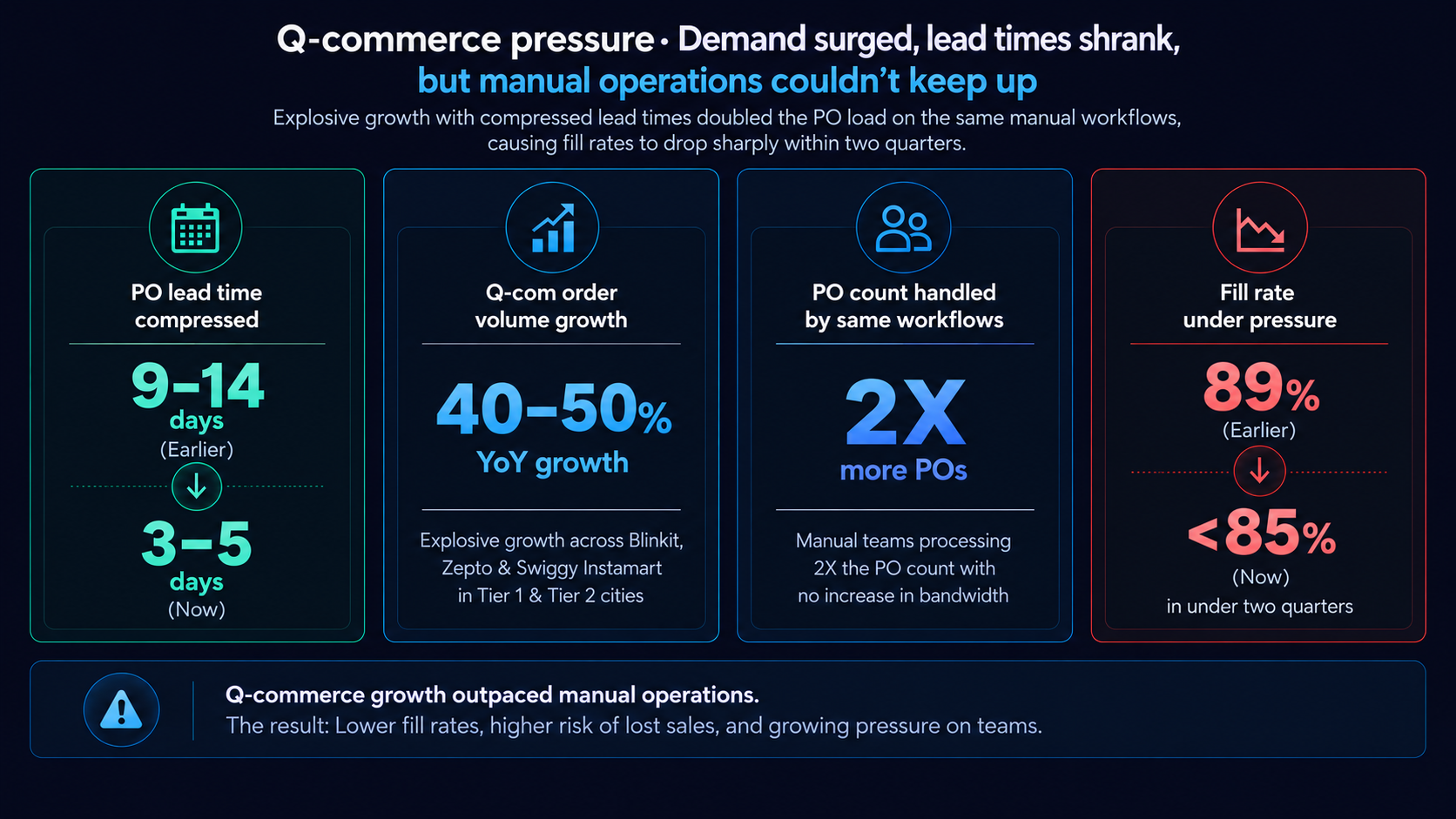
The problem started when Q-com platforms compressed their PO lead times from 9-14 days down to 3-5 days. Combined with 40-50% year-on-year growth in Q-com order volumes, this meant the company's customer success team was suddenly processing 2X the PO count with the same manual workflows.
The teams manually couldn't keep up. Fill Rates dropped from 89% to under 85% in under two quarters, and the gap widened every month as volumes grew.
The company turned to JAVIS, the autonomous order execution platform, to fix it.
Solution
From autonomous order capture to intelligent allocation, without a single line of new development
The company operates across 10 Q-commerce customers. JAVIS already had pre-built API/EDI connections with 8 of them. The remaining 2 were handled through vision AI-based document parsing within JAVIS, where inbound PO emails were automatically read.
Given that JAVIS was already the order execution engine for the company's Modern Trade, the SAP connectivity, and the O2C transaction logic were already live and battle-tested. Quick commerce did not require a new ERP integration. It rode on infrastructure that already existed.
The question was never whether JAVIS could handle Q-commerce, it was what needed to change inside the company's operations to make it work.
Three things needed to be solved:
- 1Automate order capture to Sales Order creation, end-to-end, with no manual intervention
- 2Eliminate Sales Returns and Debit Notes arising from line-level mismatches
- 3Take fill rate to 90% and above
This meant the transformation was less of a technological challenge and more of an organizational change management requirement. This transformation was completed in 3 different phases:
Phase 1
Order Capturing to Creating Sales Order in the SAP
Onboarding all 10 Q-com customers onto the automated O2C flow required no effort from the company's technology team.
Since all 10 Q-commerce customers were already transacting within JAVIS, onboarding them onto the automated O2C flow required minimal involvement from the company's technology team.
Two actions drove the activation:
Action 01
Document-based partners (2 of 10)
For the 2 document-based partners, the company's technology team set up a direct email to JAVIS, from where JAVIS parsed and ingested the inbound POs using vision AI-based document parsing.
Action 02
API-connected partners (8 of 10)
For the 8 API-connected partners, the company's business teams sent a direct request to each partner informing them to share POs with JAVIS and enabling the API integration for their accounts.
With the infrastructure already in place, all 10 customers were live in production within 10 days.
Phase 2
Identifying and Amending Line-Level Mismatches Without Human Dependency
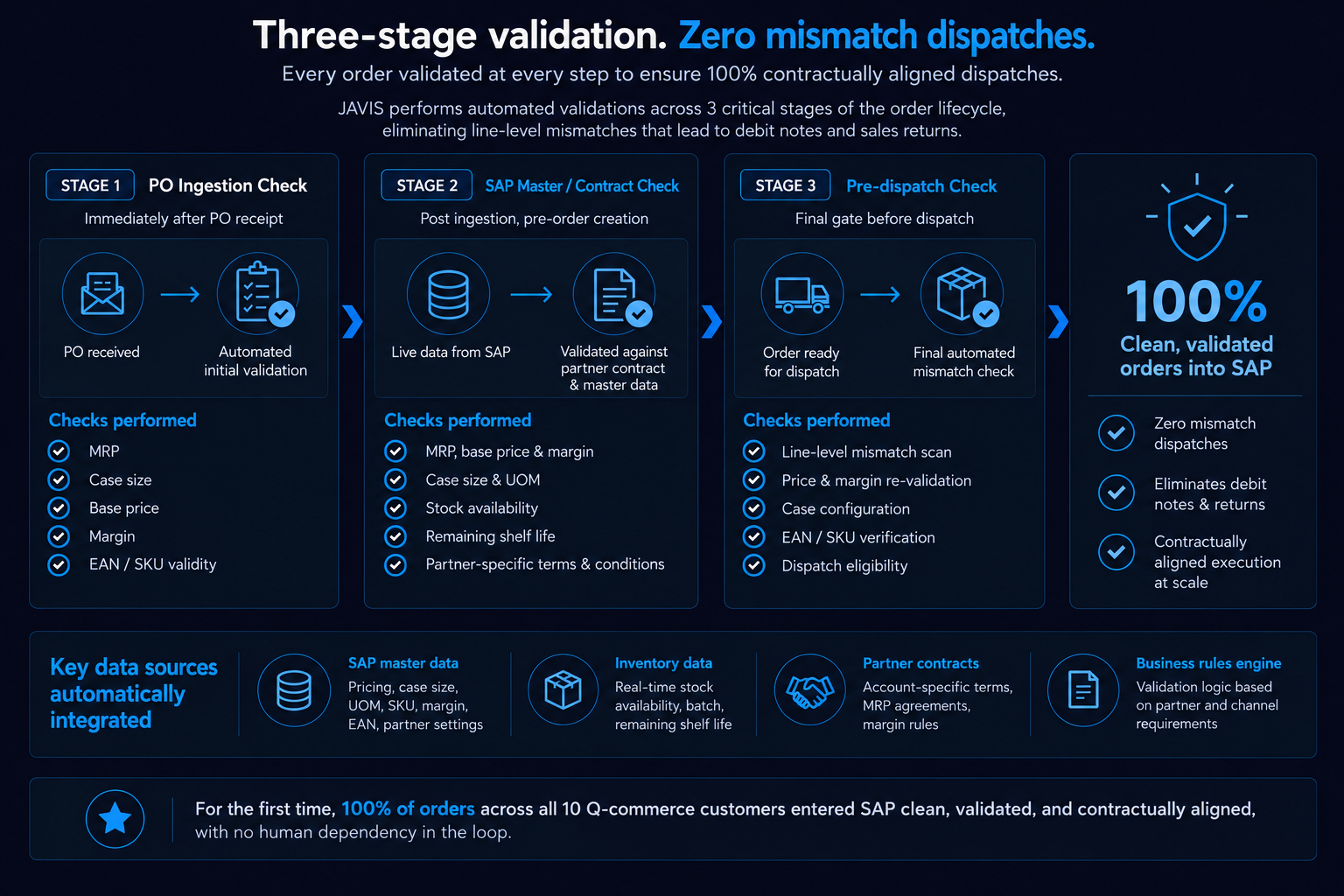
Across quick commerce, partners have specific expectations around MRP, case size, base price, margin, and EAN. A dispatch with any of these mismatches either results in a debit note or, in more severe cases, a sales return. These contractual terms are not uniform across partners, each account operates on its own set of conditions.
JAVIS's vendor contract configuration allowed the company to define and enforce partner-specific checks at the line level, ensuring each order was validated against the exact terms of that partner's agreement.
Margins, MRP, and case configuration are either high-volume or frequently changing data; maintaining them on a separate system is an operational burden. Since JAVIS was deeply integrated with the company's SAP, this data flowed system-to-system in real time. Stock data, remaining shelf life, and margin information were pulled directly from SAP into JAVIS, with no manual intervention required from the company's team.
Every incoming order line was automatically compared against SAP data. In the real world, a single-stage comparison is not sufficient, as deviations can surface at multiple points across the order lifecycle. To make it bullet-proof, JAVIS performed these checks across 3 stages of the order lifecycle, ensuring no deviation between the order document and SAP went undetected.
For amendments, JAVIS handled them across three tracks:
3 Accounts
Fully automated via API
For 3 accounts, amendments were fully automated via an end-to-end API connection between JAVIS and the partner.
4 Accounts
Automated email trigger
For 4 accounts, an automated email trigger was sent to the partner flagging the required amendment.
3 Accounts
Not applicable
For 3 accounts, amendments were not part of the contractual agreement and were not applicable.
For the first time, 100% of orders across all 10 Q-commerce customers entered SAP clean, validated, and contractually aligned, with no human dependency in the loop.
Phase 3
Automating Allocation: Replacing First-Come-First-Serve with Demand-Prioritised ATP Logic
In quick commerce, POs carry a lead time of 3 to 5 days. A missed acceptance window means a missed order, there is no recovery. Modern Trade POs, by contrast, carry lead times of 20 to 25 days, giving the fulfillment team significantly more room to fulfill the order. When both channels draw from the same depot-level inventory, how stock is allocated across them determines the overall fill rate.
The company was running allocation on a First-Come-First-Serve basis. Whichever PO arrived earliest consumed available stock first, regardless of which partner had a tighter dispatch window, an upcoming appointment, or lower stock in hand.
A Modern Trade order arriving early in the day was routinely exhausting the same SKU that a Q-com dark store needed to be dispatched by noon. Stock held against a 20 to 25 day Modern Trade PO sat aging, while a Q-com order with a same-day dispatch window went unfulfilled. The constraint was not supply, it was how available stock was being committed against competing demand.
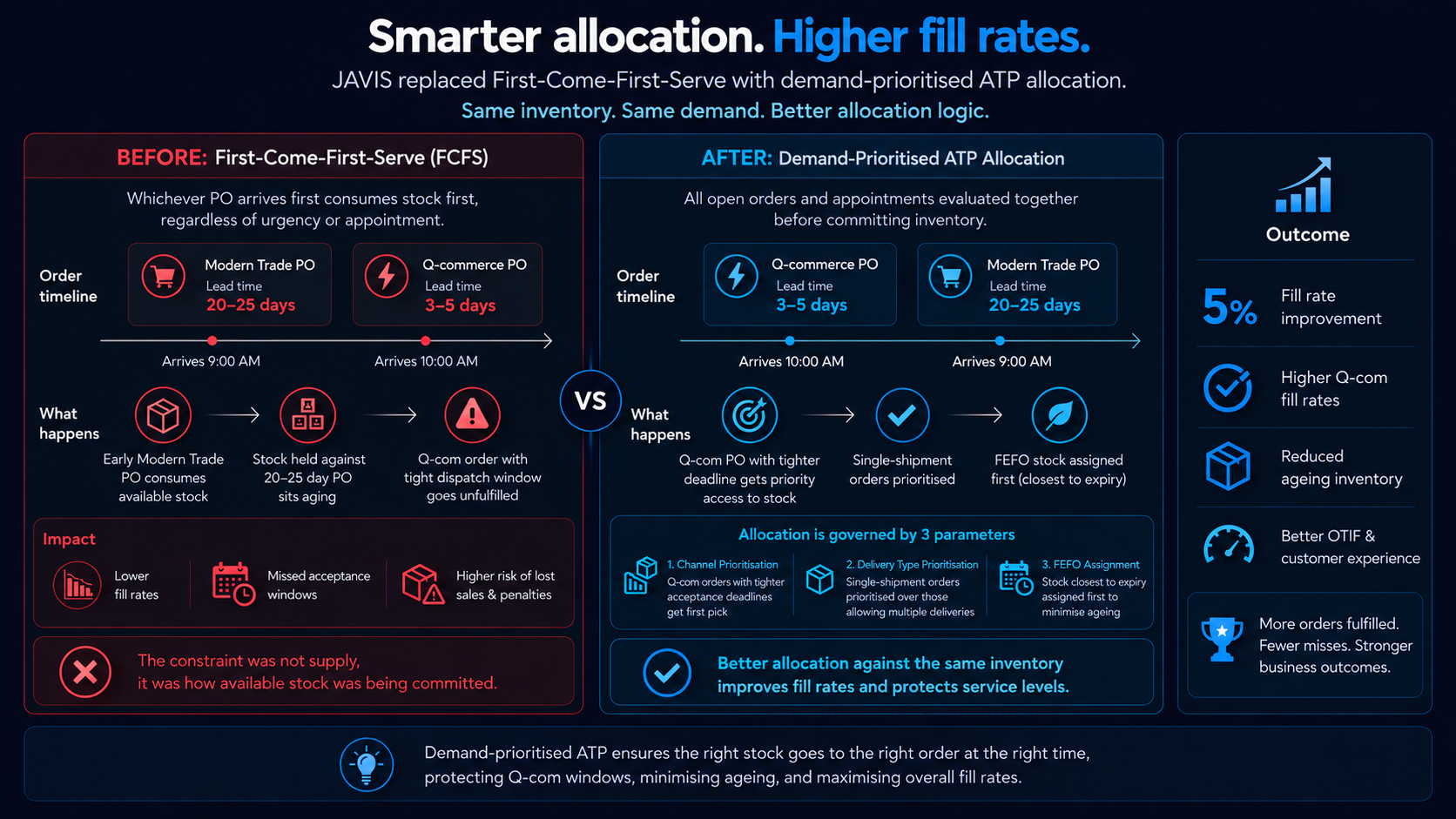
JAVIS replaced FCFS with an appointment-based stock allocation engine that evaluated all open orders and their appointments simultaneously, before committing inventory to any single order. Three parameters governed every allocation decision:
Parameter 01
Channel Prioritisation
Q-com POs with tighter acceptance deadlines received first pick of available stock over Modern Trade orders sitting in the same queue, protecting overall fill rates across the organisation.
Parameter 02
Delivery Type Prioritisation
Orders fulfillable in a single shipment were automatically prioritised over those allowing multiple deliveries, keeping OTIF numbers healthy.
Parameter 03
FEFO Assignment
Stock closest to expiry was automatically assigned first, maximising fill rates and minimising dead stock.
The same inventory, allocated differently against the same demand, resulted in fill rates improving by 5%. Available stock was committed to the orders carrying the highest cost of a miss, protecting Q-com fill rates, minimising ageing inventory, and keeping OTIF intact.
Impact
From Manual Processing to Autonomous Order Execution
The transformation delivered measurable outcomes across the company's Q-commerce O2C:
100%
Automated Order Execution
Every order across all 10 Q-commerce customers entered SAP clean, validated, and contractually aligned, with no human touchpoint in the loop.
Zero
Mismatch Dispatches
Three-stage automated validation ensured no order with a line-level mismatch on MRP, case size, base price, or EAN reached the dispatch stage, eliminating debit notes and sales returns from the Q-com channel.
+5%
Fill Rate Improvement
Demand-prioritised ATP allocation replaced First-Come-First-Serve, ensuring available stock was committed to the orders with the tightest dispatch windows and highest cost of a miss.
Final word
What began as an operational challenge evolved into a strategic transformation. With JAVIS, the company has redefined what guaranteed execution means in Indian FMCG, turning order processing into a speed, accuracy, and scale advantage at a time when quick commerce is reshaping how the country's largest consumer brands compete and win.