Implementing a Hunger-Index-Powered Allocation Engine in India's Traditional Trade Channel
As traditional trade demand became harder to serve through proportionate allocation, a ₹10,000-crore Indian FMCG brand moved beyond simple heuristics with JAVIS, implementing a hunger-index-powered allocation engine that uses distributor-level stock, sell-out, credit, lead time, and business-priority signals to improve constrained stock utilisation and protect in-market share.
Challenge
Allocation of Constrained Stock Via Simple Heuristics
In India's traditional trade channels, allocation of constrained stock, or rationalisation of stock and credit, usually happens using simple heuristics.
Either it meant a proportionate allocation, where available stock was distributed broadly across distributors, or the loudest salesperson voice won. In some cases, the distributor backed by the strongest relationship with the central order processing team had a better chance of getting stock. But this was not necessarily the best utilisation of stock for the company.
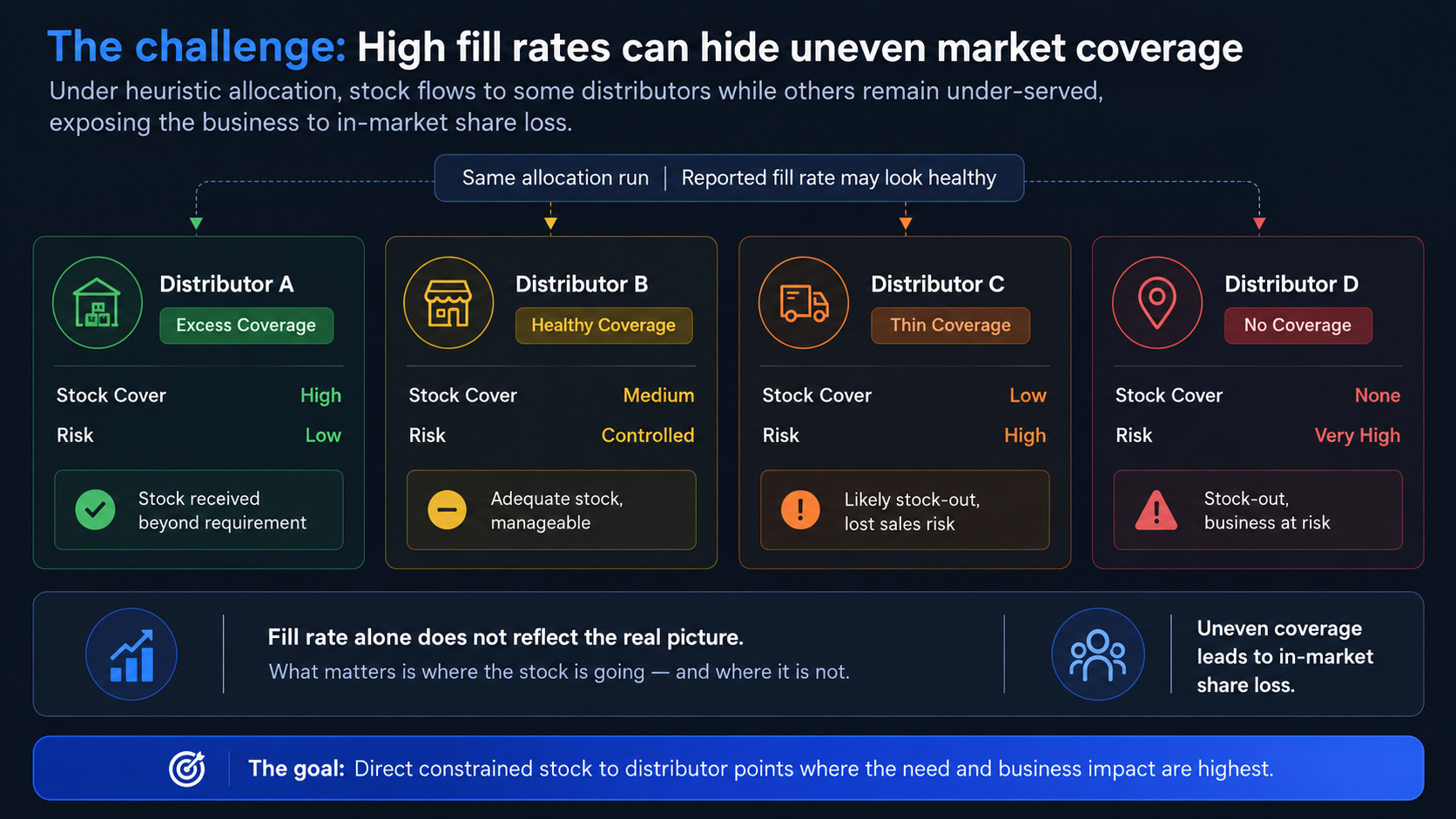
In cases of constrained stock, especially around schemes and high-priority sales periods, distributors were forward buying. Under the existing allocation framework, there were distributors with excess coverage, and there were distributors with thin coverage or no coverage.
At the end of the day, the existing practice could still show up as a high fill rate. But if stock was going to distributors who already had enough coverage while other markets were under-supplied, the business was still exposed. The result was suboptimal utilisation of stock and in-market share loss.
This is where the company's management approached JAVIS to create a data-led scientific allocation system that could reduce in-market share loss by allocating constrained stock more intelligently across the traditional trade network.
Solution
Building a scientific allocation engine powered by distributor-level hunger
JAVIS helped the company build a hunger-index-powered allocation engine for traditional trade.
The objective was not just to distribute stock. The objective was to understand where the stock was actually required, which distributor had real hunger, whether the distributor had adequate credit, and how available inventory should be assigned without breaking business and operational constraints.
The solution was built across four core layers.
Layer 1
Laying out the stock and sales data pipeline
The first step was laying out the data pipeline.
This included the end-of-day stock of a distributor and the distributor sell-out data that came once a day into the data lake.
The main challenge was to enumerate the goods in transit between the company's warehouses and the distributor location.
JAVIS solved this by accounting for stock that had already moved from the company's warehouses but had not yet reached the distributor point. This created a more accurate view of the distributor's in-hand stock position.
The engine also accounted for any order that was already there in the pipeline in SAP, including delivery orders in progress and pending deliveries.
By enumerating goods in transit, delivery orders in progress, and pending deliveries, JAVIS created an accurate closing stock position, or expected closing stock position, at a distributor point.
This was critical because allocation could not be based only on what the system saw as current stock. It had to understand what the distributor already had, what was already moving, and what was expected to land.
Layer 2
Calculating stock norms at a distributor level
Once the distributor stock position was established, JAVIS calculated stock norms at a distributor-CPC level.
This included forecasting the next seven-day run rate and ensuring that the allocation operated within the existing constrained demand.
The stock norm calculation considered lead time variation and inventory demand variation.
In simple terms, the engine did not treat every distributor equally. It looked at how demand moved at a distributor level, how lead times varied, and what level of stock was required to maintain the right coverage.
Basis demand variation and lead time variation, a norm calculation was done at the distributor-CPC level.
This helped the company move from broad allocation logic to distributor-level stock norms based on actual demand and supply variation.
Layer 3
Engineering the allocation engine and calculating hunger
The next step was engineering the allocation engine and calculating hunger.
Hunger was not just about replenishing stock or smoothing out stock cover. It was a composite signal.
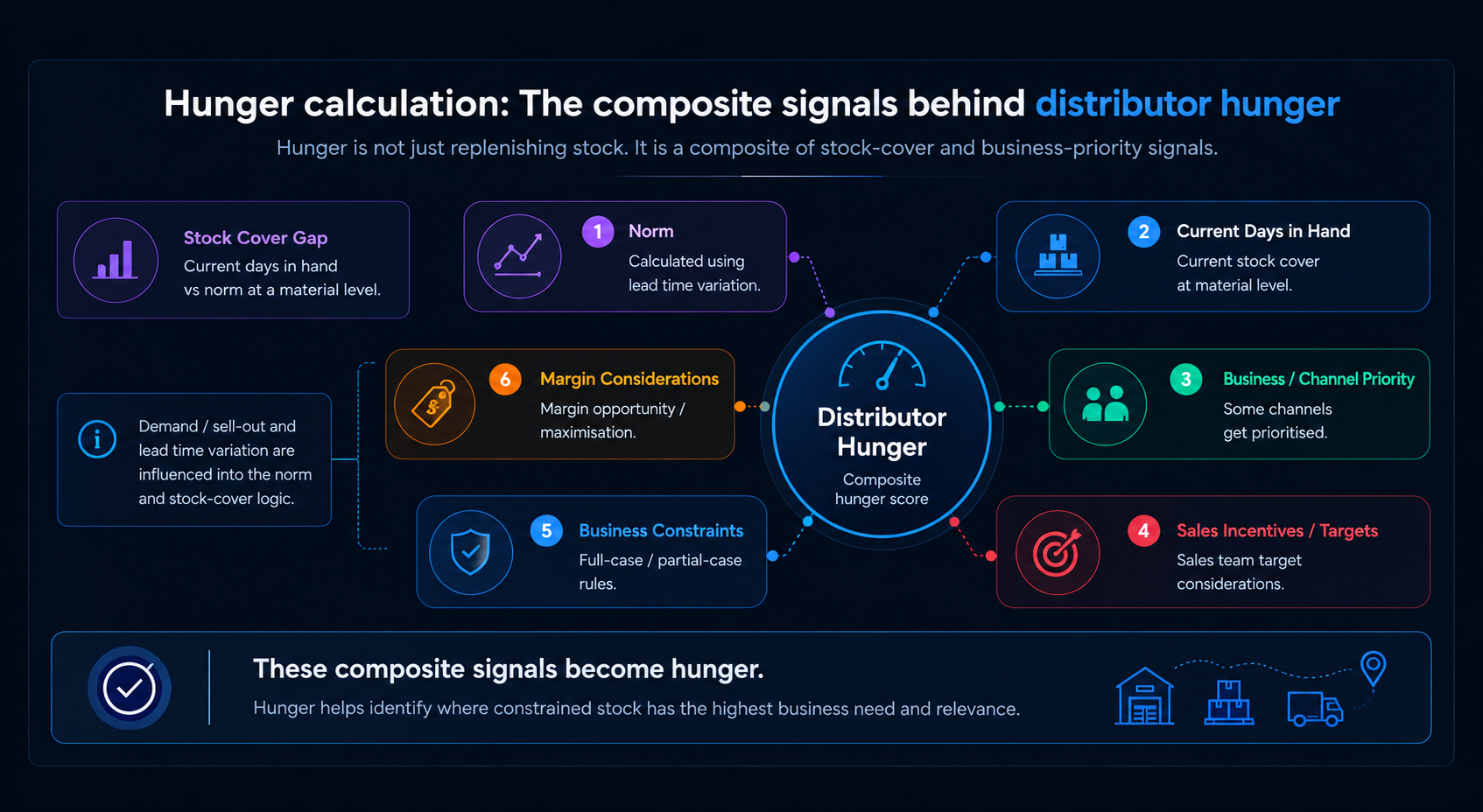
The engine considered whether the distributor had adequate credit. It considered whether there was a margin increase or margin maximisation opportunity. It considered sales team target requirements. It also considered demand and supply at a distributor level.
Basis these factors, multiple signals were created.
The final allocation engine could take in demand, supply, credit, and hunger, and then assign available stock without breaking full-case and partial-case constraints.
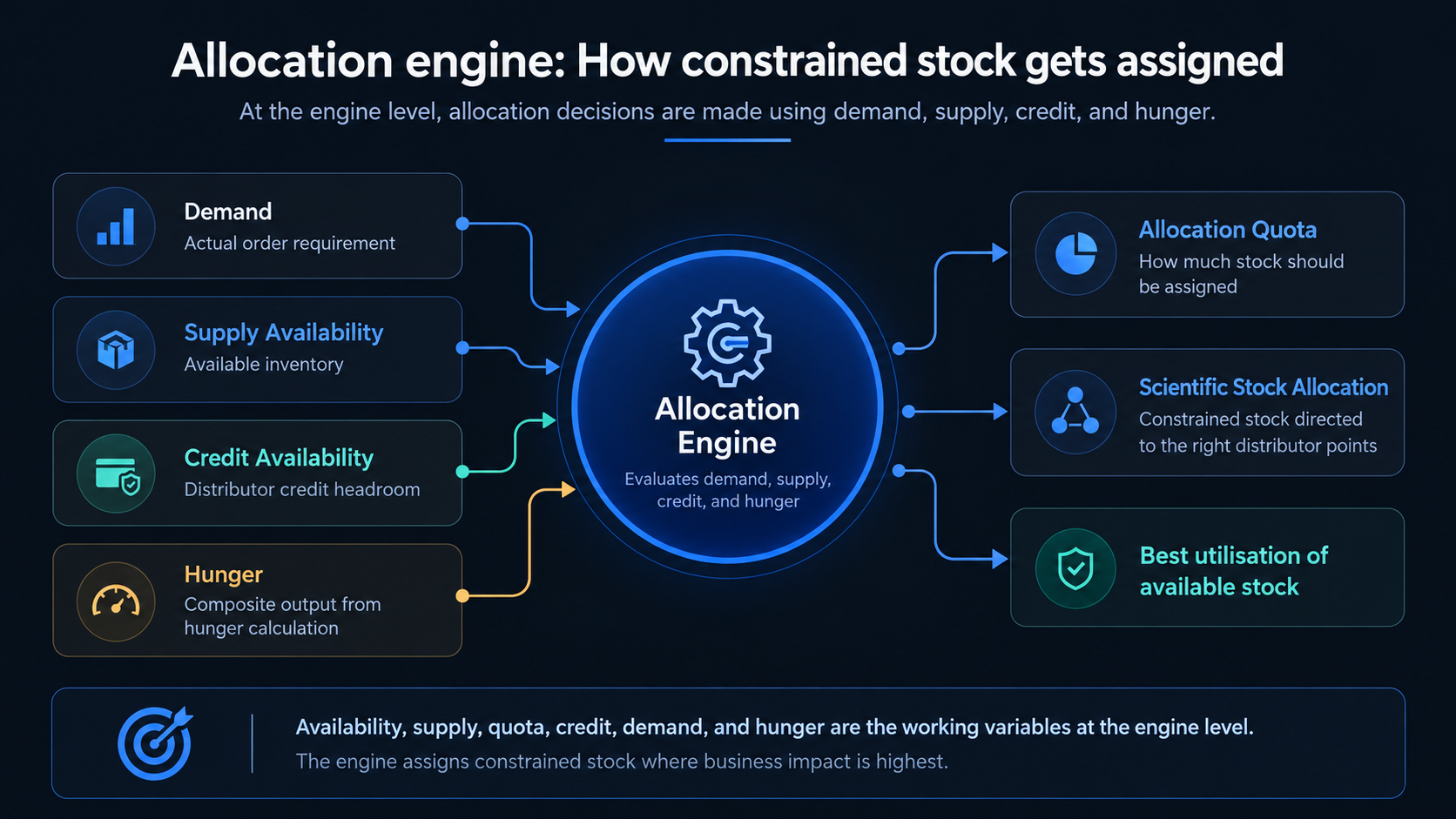
This helped the company move from simple heuristic-based allocation to scientific allocation based on distributor-level hunger.
Layer 4
Applying adaptive weightage across multiple allocation parameters
Since this was a multivariate problem, the engine needed an adaptive weightage of various parameters.
Demand, supply, stock cover, distributor credit, margin considerations, sales team targets, channel quota availability, lead time variation, and business constraints do not carry the same importance in every situation.
The way these signals interact with each other changes based on the allocation context.
JAVIS built this as a context-based adaptive weightage system, where the weightage of different parameters could change depending on the business situation.
This allowed the engine to evaluate distributor hunger more scientifically and assign constrained stock based on the best utilisation opportunity for the company.
Impact
A Scientific Hunger-Index-Powered Stock Distribution Engine
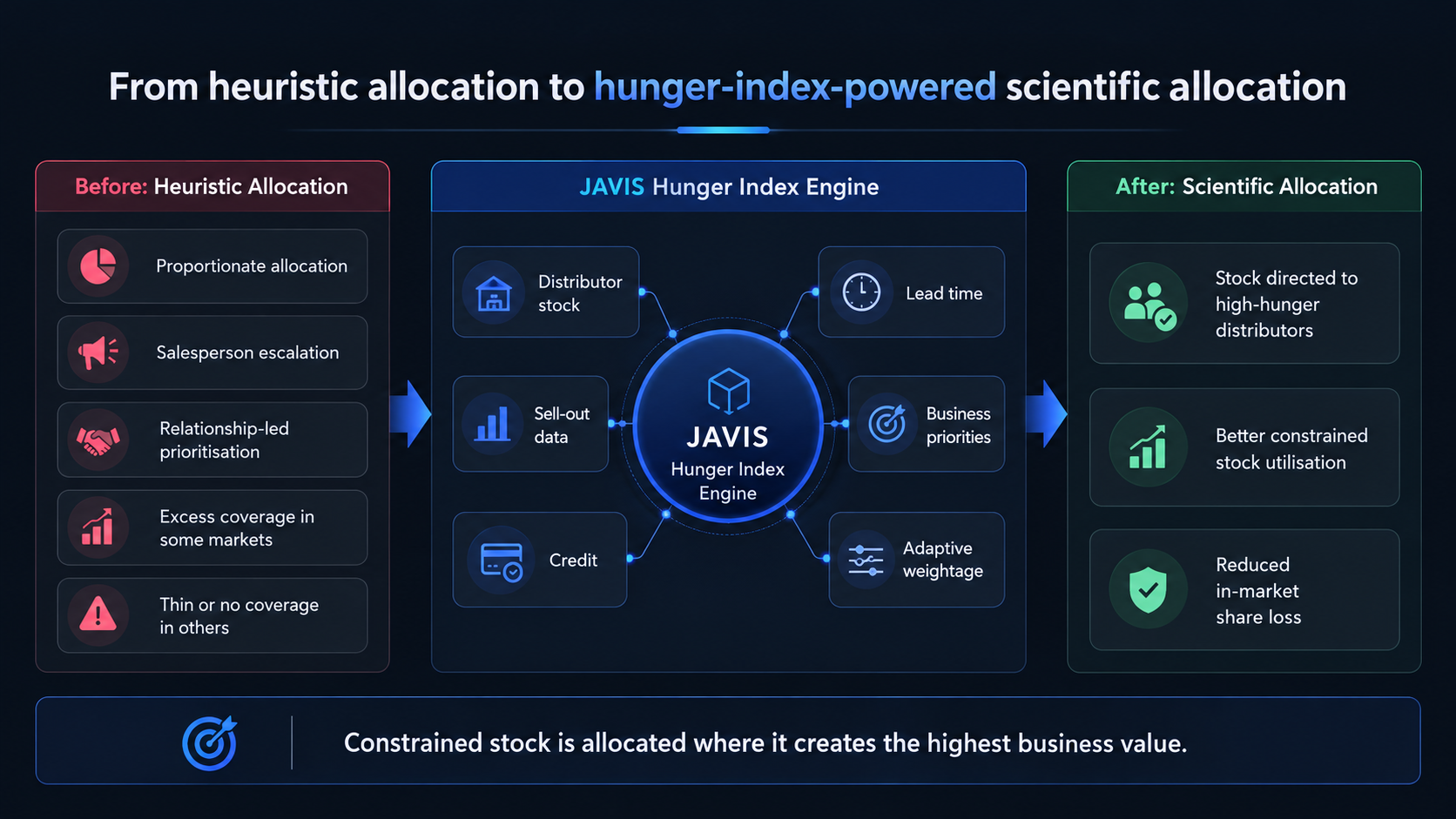
Constrained Stock Directed to the Right Distributor Points
Instead of proportionate allocation or salesperson escalation, the company could now allocate stock based on actual distributor hunger, expected closing stock, demand variation, lead time variation, credit position, and business priorities. Stock moved to the distributor points where it had the highest need and the highest business relevance.
In-Market Share Loss Reduced Through Scientific Allocation
The existing practice could show healthy fill rates while stock was going to distributors with excess coverage. The hunger-index-powered engine corrected this, directing limited inventory toward markets that were thin or at risk, reducing the in-market share loss that had been invisible under proportionate allocation logic.
A Foundation for Composite Macro Allocation Optimisation
The next step is a composite engine where truck building and route optimisation become part of a complete macro allocation optimisation layer, allowing inventory assignment, truck building, and route optimisation to work together as one integrated planning and execution system.
Final word
The company's traditional trade allocation challenge was not a lack of distribution reach. It was the absence of a scientific way to decide where constrained stock should go first.
The existing allocation practice could still show healthy fill rates, but if stock was going to distributors with excess coverage while other distributors had thin coverage or no coverage, the company was still exposed to in-market share loss.
With JAVIS, the company created a data-led, hunger-index-powered allocation engine that used distributor stock, sell-out data, goods in transit, pending deliveries, stock norms, credit, demand, supply, and business-priority signals to allocate constrained stock more intelligently across India's traditional trade channel.