Pharma Orders Processed in 15 Minutes: How a $3.8 Billion Indian Pharma Multinational Company Automated Order Execution Across 10,000+ Stockists
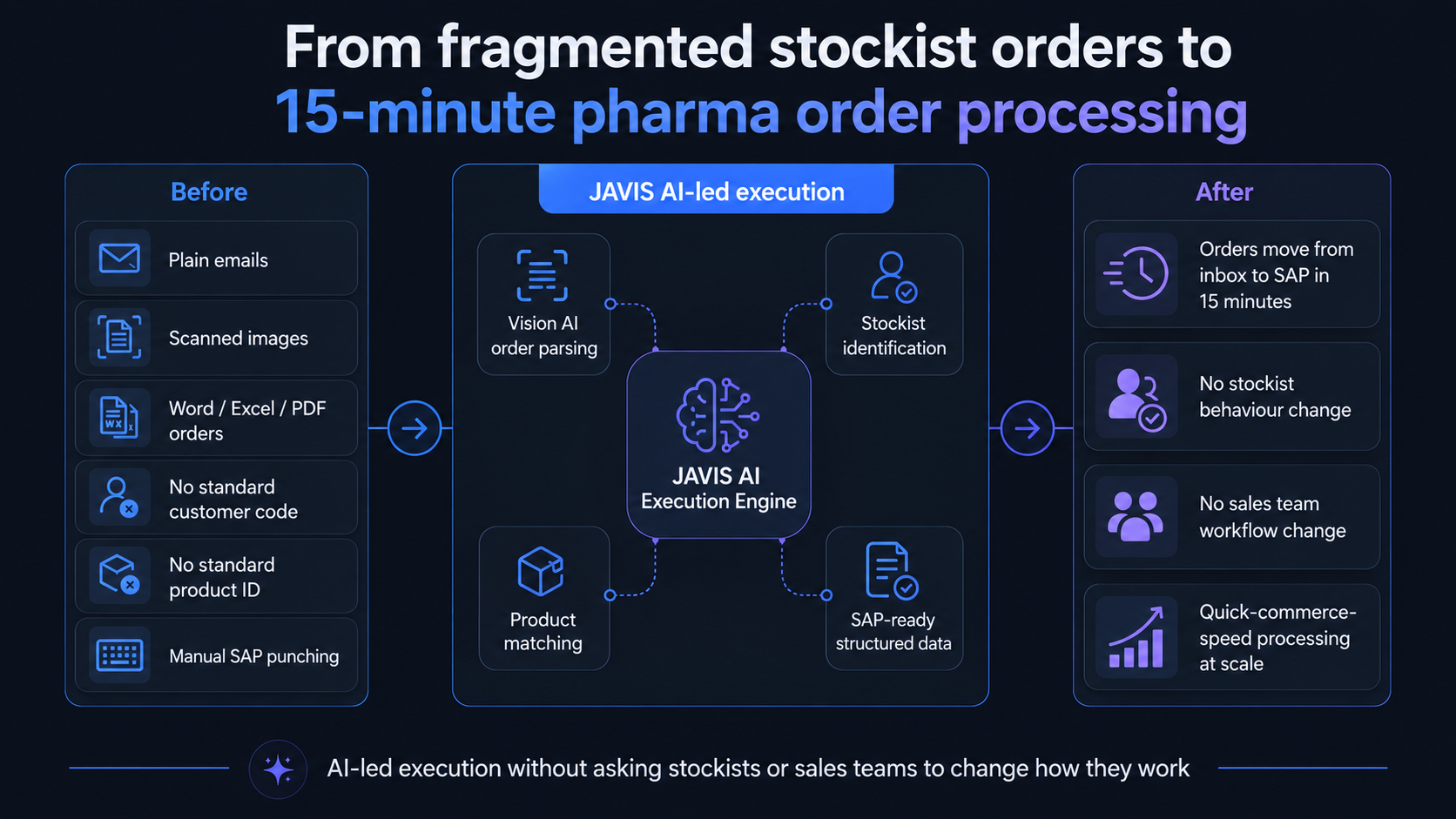
In Indian pharma distribution, every stockist works differently. Orders come from different ERPs, different document formats, and different product descriptions often without standard customer codes or product IDs. With JAVIS, a $3.8 billion Indian pharma multinational company enabled AI-led order processing without asking stockists or sales teams to change how they already work, moving stockist orders from inbox to SAP at quick-commerce speed.
- Format coverage
- 100%
- Inbox to SAP
- 15 min
- Stockists
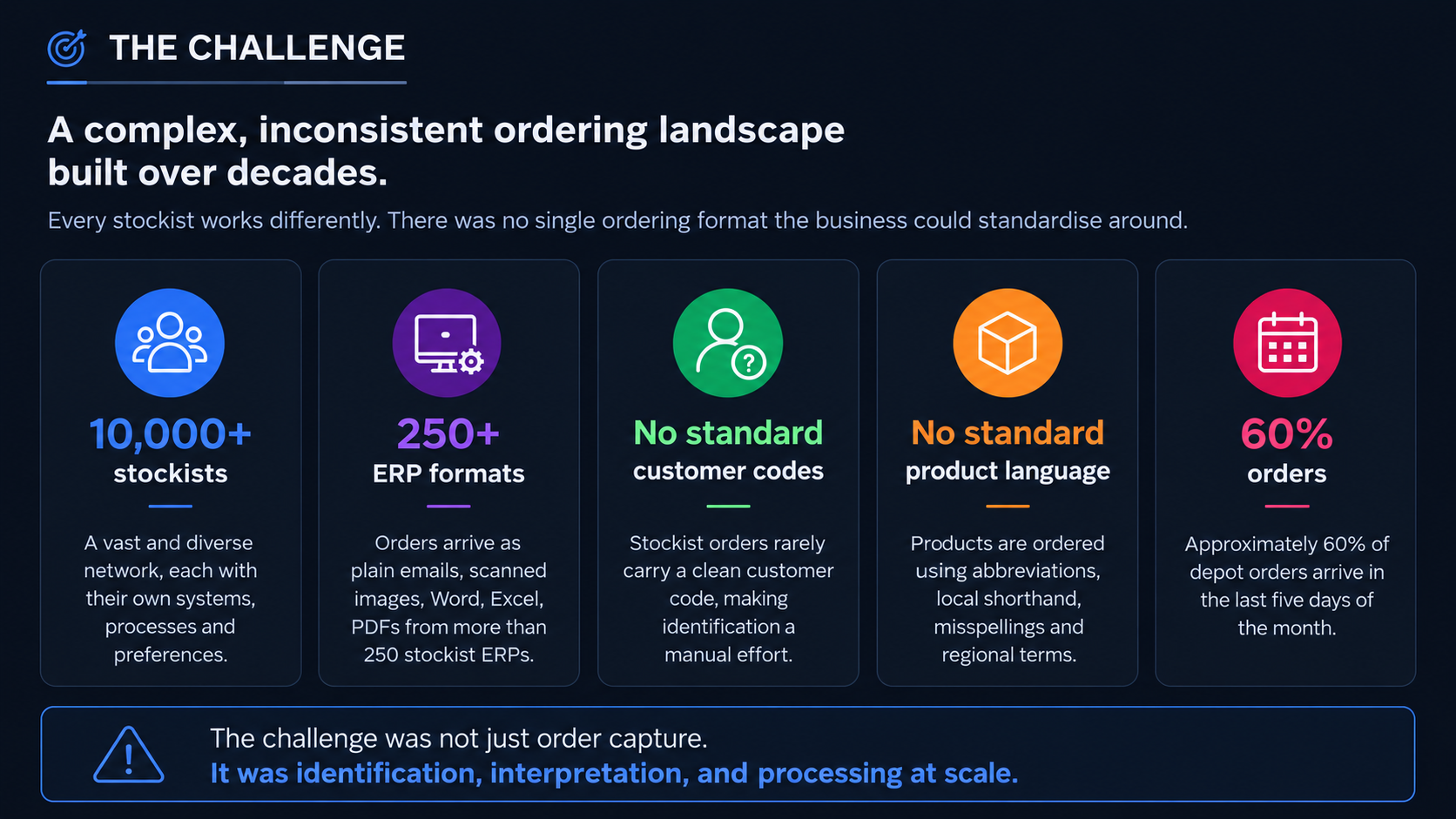
- 10,000+
- Stockist ERP Formats
- 250+
Challenge
Ten thousand stockists ordering in every format imaginable. One manual operation trying to keep up
The structural problem in Indian pharma distribution is fragmentation, not volume.
Every stockist runs their own ERP. Every ERP produces a different order document. Orders arrive in the stockist's own language and product shorthand with no standard layout and no standard product ID. A stockist does not order by a product code. They order by what they know - a brand name, an abbreviation, a regional description that means nothing to a central system. Across 10,000 stockists, no two describe the same product the same way.
Depot teams were manually identifying the sender, interpreting the product description, and punching every order into SAP. Every order required human judgment before it could move forward.
The third dimension was timing. Approximately 60% of depot orders arrive in the last five days of every month. The fragmentation that existed every day became impossible to manage manually when the entire month's volume landed in five days.
The company turned to JAVIS, the autonomous order execution platform, to build it.
Solution
AI-led order execution without changing how stockists order
The company did not need a new ERP for stockists. It did not need 10,000+ stockists to adopt new portals, templates, or structured order formats. It needed an AI-led execution layer between informal stockist ordering channels and SAP.
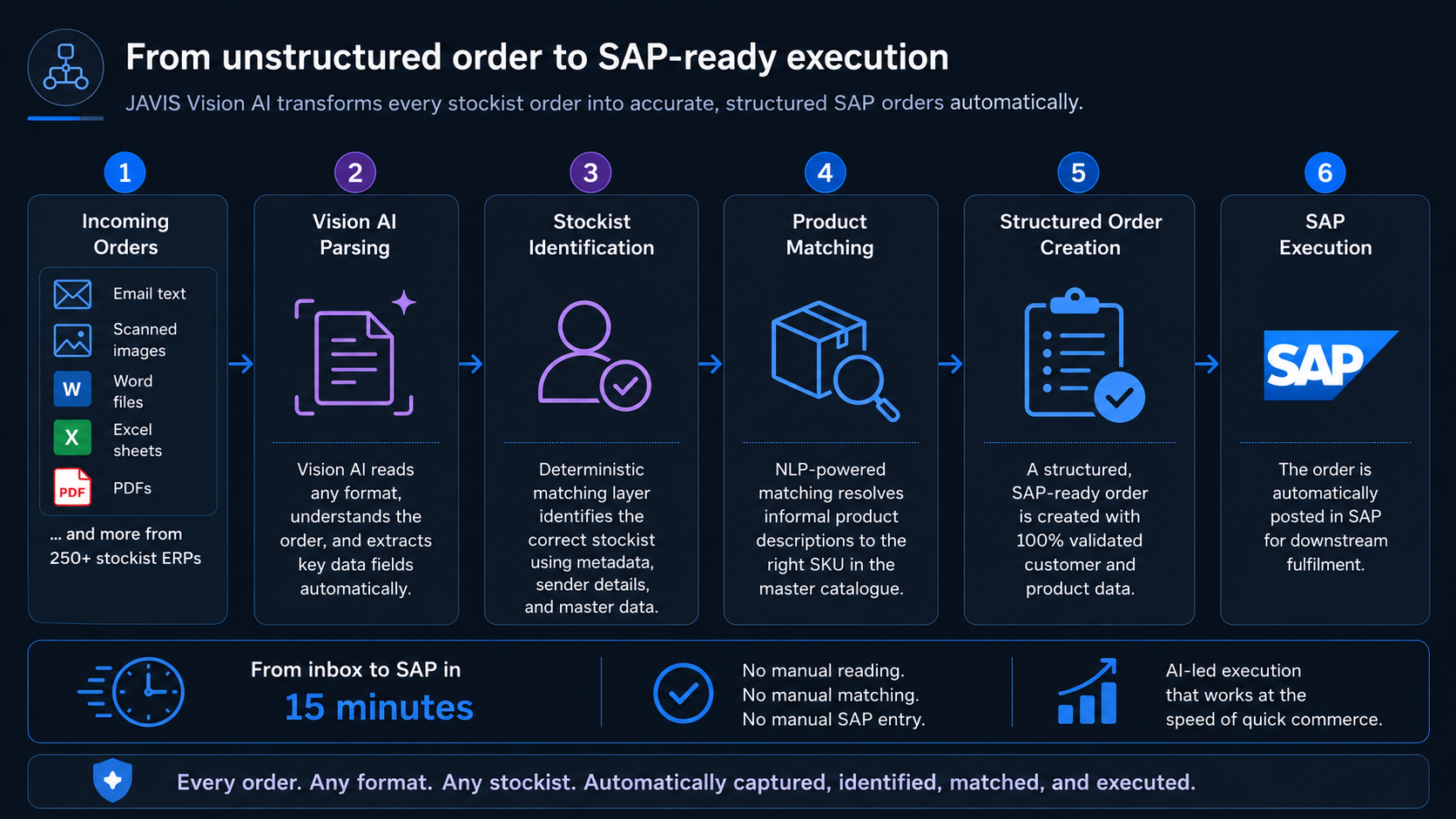
JAVIS was already processing orders across hundreds of document formats and distribution networks for large FMCG and pharmaceutical companies. The Vision AI capability to read unstructured order documents, identify customers, map product descriptions, and create structured SAP-ready order data was already live and battle-tested.
The transformation was completed in two phases:
- 1Deploy the Vision AI stack at a single depot and validate accuracy across every format, stockist code, and product description before scaling.
- 2Extend the validated stack across all 19 depots pan-India without reconfiguration and without asking a single stockist to change how they order.
Phase 1
Validating the Vision AI stack at a single depot
The rollout began with one depot. Before scaling across the national network, JAVIS deployed the full Vision AI stack at a single location to validate accuracy, edge-case handling, and SAP integration reliability under real production conditions.
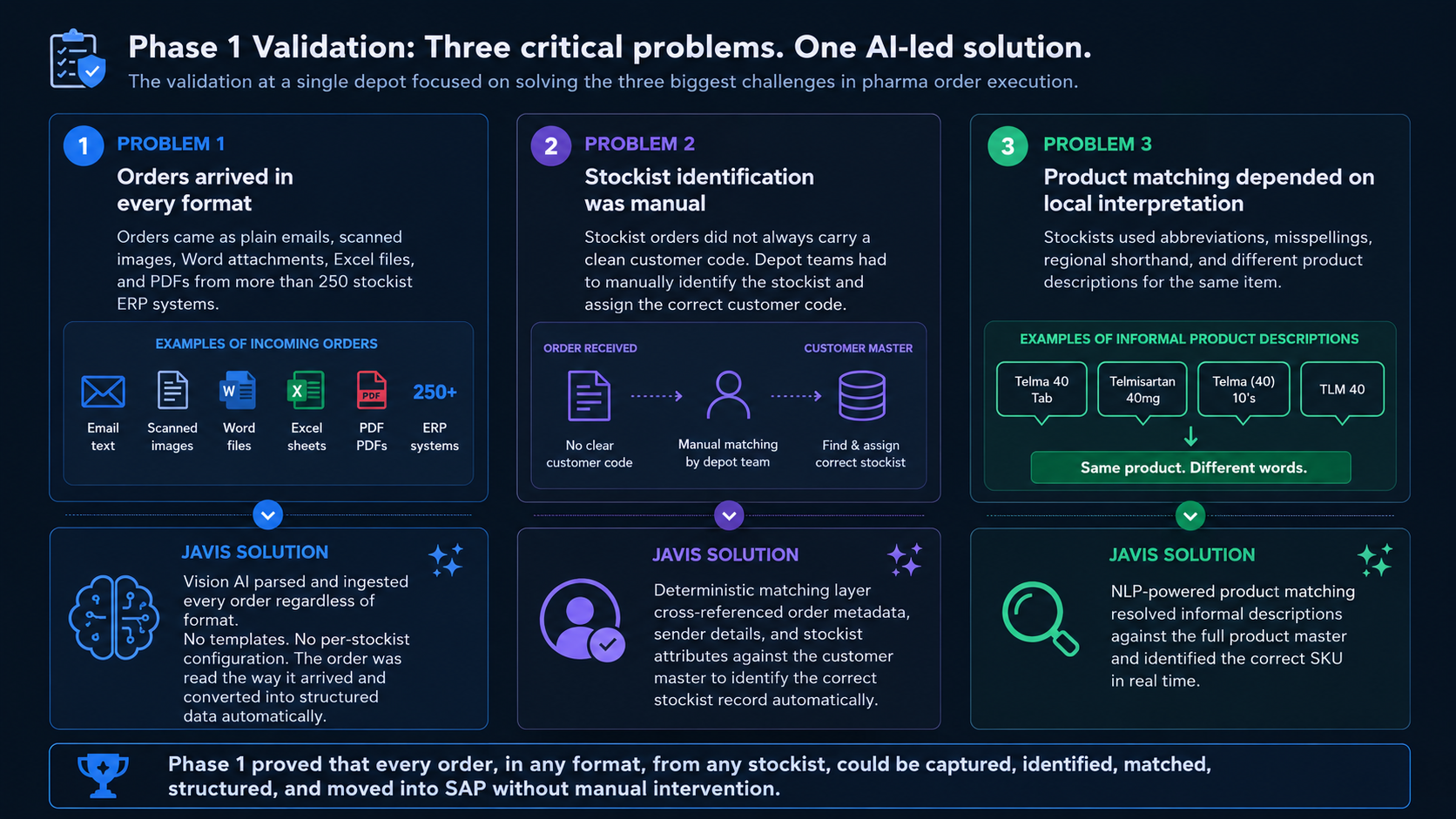
The validation focused on three problems.
Signal 01
Orders arrived in every format
Orders came in the same way the market had always sent them, plain email text, scanned handwritten order sheets, Word attachments, Excel files, and PDFs from more than 250 stockist ERP systems. JAVIS Vision AI parsed and ingested every order regardless of format. No templates. No per-stockist configuration. The order was read the way it arrived and converted into structured data automatically.
Signal 02
Stockist identification was manual
Stockist orders did not always carry a clean customer code. Depot teams had previously been identifying which stockist had placed the order, matching it against the company's customer master, and assigning the correct customer code before the order could move forward. JAVIS automated this through a deterministic matching layer that cross-referenced order metadata, sender details, and stockist attributes against the customer master to identify the correct stockist record.
Signal 03
Product matching depended on local interpretation
Stockists did not always write product names the way they appeared in the company's master catalogue. Product descriptions were often abbreviated, misspelled, written in regional shorthand, or described differently by different stockists. JAVIS used NLP-powered product matching to resolve these informal descriptions against the full product master and identify the correct SKU in real time.
What the single-depot validation proved
The single depot surfaced the edge cases the wider network would create: unusual formats, unfamiliar stockist references, local product names, shorthand descriptions, and order documents that did not follow any standard structure.
Each edge case was resolved and validated before national scale-up. For the first time, every order arriving in the depot inbox could be captured, identified, matched, structured, and moved forward without manual order entry.
Phase 2
Pan-India rollout across 19 depots
With the Vision AI stack validated at a single depot, the company scaled the same approach across the country. JAVIS rolled out across 19 depots pan-India. No new templates were created. No stockist was asked to change how they ordered. No sales team was asked to change how they collected or forwarded orders.
The scale was significant: a large volume of orders every month, arriving across 19 depots in every format the market used. Regional shorthand differed by state. Local product naming conventions varied from depot to depot. Stockist names were not always recorded the same way across teams. The same AI-led matching logic that had been validated in Phase 1 now ran at national scale.
The month-end surge no longer meant depot teams manually entering orders through the night. Orders that previously waited for someone to read, interpret, match, and punch them into SAP now moved the moment they arrived. Across 19 depots and a large volume of monthly orders, quick-commerce-speed processing became the operating baseline.
Impact
From manual pharma order entry to 15-minute order processing
The transformation delivered measurable outcomes across the company's pharma order execution network.
97.6%
Orders processed within 15 minutes
The majority of the incoming stockist order, regardless of format, ERP source, customer identifier, or product description, moved from inbox to SAP within 15 minutes. What previously required manual reading, interpretation, matching, and SAP entry now cleared automatically.
250+
Stockist ERP formats handled without templates
JAVIS Vision AI processed plain emails, scanned images, Word files, Excel sheets, and PDFs from more than 250 stockist ERP systems. No stockist was asked to change their ERP, ordering format, or document structure.
19
Depots. Pan-India. Minimal Manual Intervention.
Across 19 depots, orders moved from inbox to SAP automatically regardless of volume. The month-end spike no longer depended on depot team capacity. The operation now scales with demand, not with headcount.
Final word
The market was never going to standardise. Ten thousand stockists, their own ERPs, their own language, their own way of ordering. With JAVIS, the company stopped asking the market to change and built an AI layer that absorbs it as it is. That is what quick commerce speed looks like in Indian pharma distribution.